


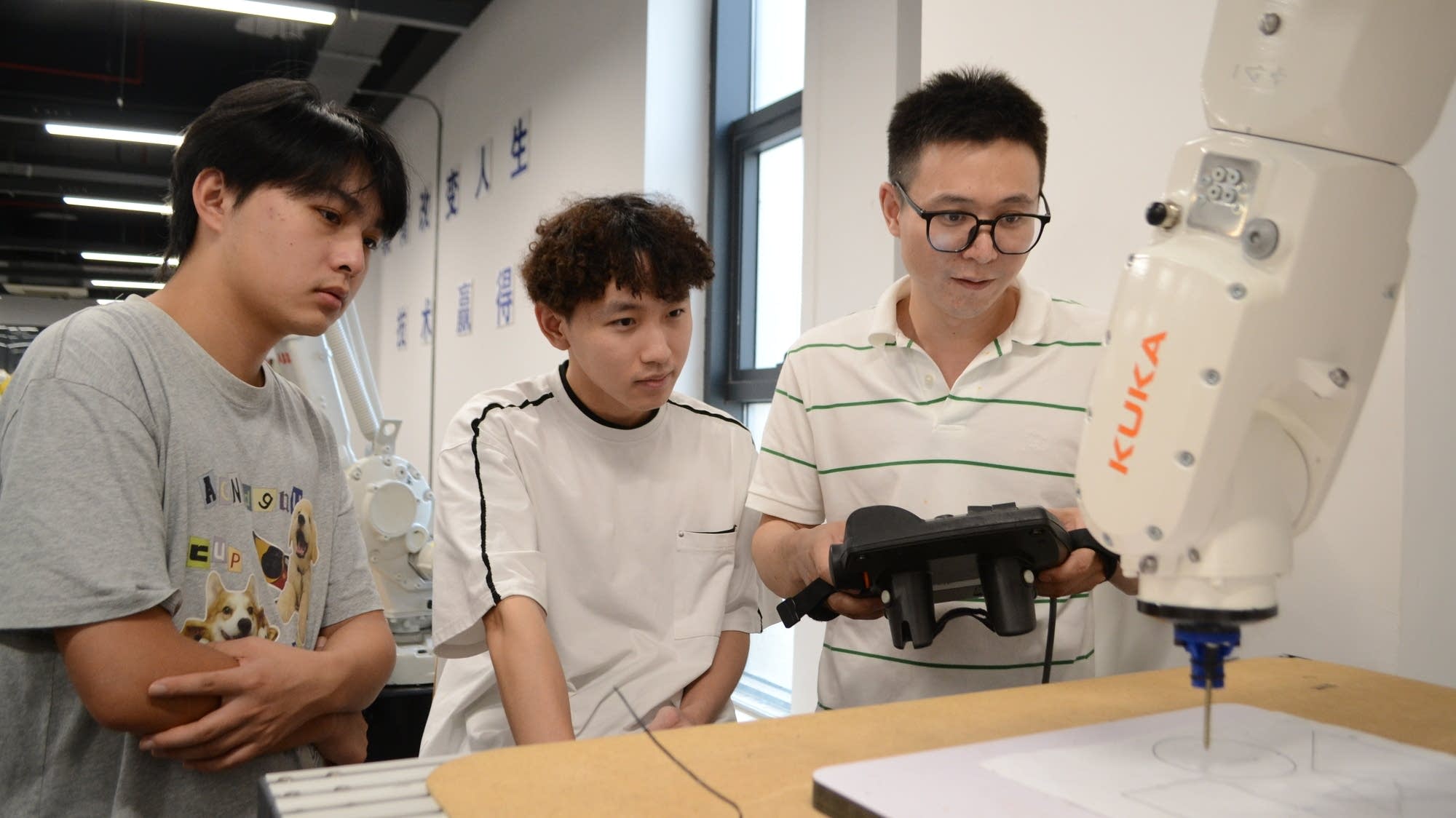
Zhinanche Robot Technology in China’s eastern city of Nanjing gives students hands-on experience with industrial robots.
Its main workshop is lined with robotic arms on one end. These machines are the same ones found in many Chinese factories.
During one of its robotics classes, about 10 students, all young men, organized into groups of three around each robotic arm. The students were given papers printed with rectangles and circles and tasked with programming the robotic arms to trace the shapes.
Mastering these robotic arms is key to getting a decent job in the manufacturing sector. Many Chinese factories have been automating as the labor pool shrinks and fewer educated young people want to go into manufacturing.


Students at Zhinanche take a three-month course about industrial automation. At the end of the course, an instructor said more than 95% of the graduates get a job.
Charles Zhang/Marketplace
“Many young people don’t want to do basic factory jobs,” founder of Zhinanche, Liu Zenglong, said. “So, manufacturing is turning from labor intensive to technology intensive.”
In China’s new five-year plan, which will guide the world’s second largest economy until 2030, top Communist party leaders have pledged to boost manufacturing even more. However, the manufacturing sector has tens of millions of such skilled jobs going unfilled, according to China’s ministry of education.
Meanwhile, young people, and there are a record 12.2 million graduates this year, are struggling to find suitable opportunities.
That is because of a mismatch between the demands of the job market and labor supply. Schools like Zhinanche are trying to bridge that gap.


Zhinanche student Tang Jing stands by a simulation of an automated production line. He’s an electrical engineer by training but wants to change his career path and become an automation engineer.
Charles Zhang/Marketplace
At the end of a three-month course, graduates from Zhinanche can work as automation engineers.
“Take the iPhone for example. It’s manufactured in China by Foxconn. But who built the production line for the iPhone? It was another company with automation engineers,” Liu said. “And once the production lines arrive at Foxconn, they need someone to calibrate, operate and repair the machines.”
Zhinanche trains a variety of people needed along the automated production line. The firm has three branches in eastern China with over 200 students.
Among them is 25-year-old Tang Jing, who had been working as an electrical engineer for a couple of years. He was with a state-owned firm, which meant job security and better benefits compared to the private sector, but wasn’t happy.
“I was maintaining machines for a pollutant management system at a natural gas well. The job was hard and not what I wanted. So, I quit and came to Zhinanche,” he said.
Tang is optimistic about his job prospects once he leaves Zhinanche.
The school said many graduates here have gone on to work with auto manufacturers such as Kia, BYD, and battery companies like CATL.

Teachers and students troubleshoot during a robotics class at Zhinanche.
Charles Zhang/Marketplace
“My ideal job is to be an automation engineer specializing in electrical design. It is a stable job and doesn’t require a lot of business trips,” Tang said.
Automation engineers used to be trained on the job through apprenticeships. However, those were the days when people would stay with the same employer for about 10 years, according to Liu.
“Now people change jobs very quickly. If a worker joins a company for a year or two, would the company spend six months to a year to train them?” he said.
Liu thinks not. So, it is up to schools like his to get workers ready. However, Zhinanche does not train just anyone.

A wall in the Zhinanche training center is covered with wishes by students about finding stable jobs with good pay. One student hopes to earn $50,000 a year, which is far higher than the average salary in China.
Charles Zhang/Marketplace
“We only take people who have a background in computer science, mechanical or electrical engineering,” Liu said.
That is a big obstacle for most Chinese. Some 62% of adults in China lack a high school degree, according to the latest statistics from 2020, versus 12% in the U.S.
At the same time, the ones who have had post-secondary education are less attracted to factory work.
“The automation sector is desperate for people who can calibrate and debug PLC [industrial computers]. There’s a huge shortage in the sector because the work environment isn’t great and the workload is big,” Zhinanche instructor, Wang Xun, said.

Liu Zenglong identified a shortage of workers with good hands-on skills in industrial automation, so he established a training center to provide workers to many industrial manufacturers.
Charles Zhang/Marketplace
However, as China’s economy becomes sluggish, Wang is starting to see a shift.
“In 2019, many of my students were working and wanted to re-train in automation, but now I have more students who are new college graduates, who don’t have good job prospects,” he said.
The youth unemployment rate in September was 17.7%. It is very different for graduates at Zhinanche, according to Wang.
“Basically everyone from our school can find a job, over 95% of them.”
Additional research by Charles Zhang.
link