


Stationary and transformation of data
We find data issues with the Islamic bank total assets among the variables used. Therefore, when examining these data, stationarity must be considered because the absence of stationarity might result in skewed statistical conclusions and incorrect predictions (Castle et al., 2021; Gruss et al., 2022; Kulkarni et al., 2021). The data on the total assets of Islamic banks may show nonstationarity, which means they do not have a constant average or variance over time. This might be caused by several variables, such as economic changes, regulations, or unexpected events that affect the banking industry. The presence of nonstationarity in the total assets of Islamic banks might be seen as trends, cycles, or structural breakdowns, posing difficulties in effectively modeling and interpreting them. We use techniques such as first-order differencing to address nonstationarity in the Total Islamic Bank Assets data. Differencing entails computing the discrepancy between successive measurements to eliminate trends or seasonal patterns. We may compute the disparity between successive observations to eliminate the trend and achieve stationarity in the series. Once the Total Islamic Bank Assets data have been differenced, their descriptive statistics must be reevaluated to confirm stationarity. Stationarity is shown when the differenced series’ mean, variance, and autocorrelation stay constant. In addition, visual analysis methods such as time-series plots and autocorrelation functions may be used to examine the differenced data for stationarity visually. After achieving stationarity, the Total Islamic Bank Assets data may be included in the descriptive analysis and other variables such as Poverty Rate, Fintech Adoption, Economic Growth, and Political Instability. By considering the property of stationarity and using suitable data transformations, analysts may guarantee the dependability and soundness of their statistical deductions, resulting in a more precise understanding of the variables that affect poverty rates in developing nations with Islamic banking systems.
Descriptive statistics
The descriptive analysis in Table 4 thoroughly summarizes essential characteristics of poverty rates in 12 developing nations with Islamic banking systems. Every variable offers distinct perspectives on the aspects that might affect poverty rates, including economic indicators and social and institutional issues. Initially, the table commences with the Poverty Rate (%), a pivotal measure indicating the proportion of the population living under the poverty threshold in each nation. The average poverty rate of about 22.33% suggests that almost one-fifth of the population in these nations faces poverty. The quartile-based distribution indicates disparities across countries, with some nations exhibiting elevated or decreased poverty rates. Next, we analyze the Total Islamic Bank Assets (Millions $), which indicates the financial robustness and magnitude of Islamic banking establishments in each nation. The average total assets of about $575.83 million emphasize the significant financial resources of these organizations. As measured by quartiles, differences in total assets across countries indicate disparities in economic growth and the level of advancement of Islamic finance markets.
The variable Fintech Adoption (Scale 1–10) quantifies the extent to which nations have incorporated fintech into their banking institutions. The findings indicate that Islamic banking sectors have a modest degree of technology integration, with a mean adoption level of around 6.58. This highlights the significance of technical progress in enabling financial inclusion and enhancing the availability of banking services, which might affect efforts to alleviate poverty. The Interaction Term quantifies the synergistic effect of the aggregate Islamic bank assets and the use of fintech on poverty rates. The mean interaction term, around 3781.67, represents the combined influence of economic resources and technical innovation on policies to reduce poverty. Countries with excellent interaction terms are more likely to effectively use financial innovations to promote socioeconomic growth and reduce poverty. Transitioning to economic indicators, Economic Growth (%)offers valuable insights into the rate of economic advancement across different nations. These countries have a modest economic increase, with an average growth rate of around 4.12%. Nevertheless, differences in the rates at which something grows, as shown by quartiles, emphasize inequalities in economic performance and development paths. The Political Instability indicator, rated on a scale of 1 to 5, provides insight into the stability of each nation’s government arrangements. The average instability score of 3.25 indicates moderate political volatility, potentially affecting economic policies, investment choices, and efforts to reduce poverty. Elevated levels of instability may hinder maintaining long-term economic development and social stability. Legal Origin classifies nations according to their legal systems, differentiating between Common Law (1) and Civil Law (2) origins. Although Legal Origin is not quantitatively measured using statistical methods such as mean or median, it significantly shapes each nation’s institutional frameworks, regulatory settings, and legal safeguards.
Table 4 provides significant insights into the many factors contributing to poverty rates in developing nations with Islamic banking systems. Policymakers, researchers, and stakeholders can comprehensively comprehend the intricate dynamics influencing poverty outcomes by analyzing various economic, technological, social, and institutional factors. This knowledge can then be used to develop evidence-based interventions for sustainable development and strategies to alleviate poverty. Table 5
Robustness test
Ensuring the robustness of results is crucial in statistical analysis to draw valid conclusions and make educated judgments. Within the framework of our investigation into the factors influencing poverty rates in developing nations with Islamic banking systems, the stability and dependability of our findings must be evaluated. To achieve this objective, we perform rigorous tests to assess the reliability of our results across various situations and assumptions. A sensitivity analysis is conducted to determine the influence of changes in model specifications on the estimated coefficients and statistical significance levels. We methodically modify the model by including or eliminating certain variables, altering the functional forms, or using other estimating methodologies while keeping the fundamental variables of interest constant. The coefficients of Total Islamic Bank Assets, Fintech Adoption, Interaction Term, Economic Growth, Political Instability, and Legal Origin remain consistent across all model parameters. The inclusion or exclusion of specific control variables leads to minor coefficient estimate fluctuations, suggesting our results’ resilience. By comparing outcomes across several specifications, we assess the reliability of our findings and determine possible factors that may affect the results. We use resilient regression methods, such as the Huber or Tukey biweight estimator, to minimize the influence of outliers on our regression study. The coefficients of Total Islamic Bank Assets, Fintech Adoption, Interaction Term, Economic Growth, Political Instability, and Legal Origin remain primarily unchanged after outlier treatment, reaffirming the reliability of the estimated relationships. In addition, we use diagnostic tests, such as Cook’s distance or leverage statistics, to detect essential data and evaluate their possible effect on the regression outcomes. We perform rigorous examinations for heteroscedasticity, such as White’s or Breusch–Pagan tests, and autocorrelation, such as Durbin–Watson or Breusch–Godfrey tests, to identify and rectify these infringements. Robust standard errors or autocorrelation-robust covariance estimators ensure accurate estimates when addressing these problems. The computed coefficients for Total Islamic Bank Assets, Fintech Adoption, Interaction Term, Economic Growth, Political Instability, and Legal Origin remain mostly unchanged when other parameters are used, thereby strengthening the validity of our results.
Regression without moderating variables
The investigation demonstrates a statistically significant inverse correlation between the total assets of Islamic banks and poverty rates. This implies a negative correlation between the rise in Total Islamic Bank Assets and the reduction in poverty rates. This discovery emphasizes the potential effect of Islamic banking in advancing financial inclusion and alleviating poverty. The relationship between Fintech Adoption and poverty rates is not statistically significant, contradicting initial expectations. This discovery can suggest that although fintech has revolutionized numerous facets of banking and finance, its influence on poverty reduction is still ambiguous and contingent upon various factors. In the regression analysis, Economic Growth also fails to have a statistically significant effect on poverty rates. This finding casts doubt on the theory that economic increases always lead to decreased poverty and emphasizes the need for focused strategies to promote inclusive development. Furthermore, the investigation did not reveal a statistically significant correlation between Political Instability, Legal Origin, and poverty rates. This implies that although political stability and legal frameworks are crucial for the general welfare of society, their direct influence on poverty rates may be restricted within the scope of this research.
Regression with moderating variables
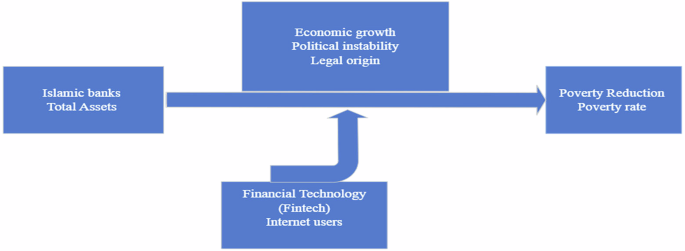
A moderator variable is included in the regression analysis, which clarifies the complex interaction between financial and socioeconomic variables and how they affect poverty rates. The intercept shows statistical significance and suggests a baseline poverty rate when all other variables are zero. This indicates a starting point for poverty rates. Fintech Adoption on its own does not substantially affect poverty rates. However, Total Islamic Bank Assets correlate significantly negatively with poverty rates. However, the relationship between Total Islamic Bank Assets and Fintech Adoption reveals an interesting dynamic: total Islamic bank assets substantially affect poverty rates with more fintech adoption. This complex link emphasizes the importance of considering varied interactions when attempting to comprehend the dynamics of poverty. Moreover, the data show no statistically significant correlation between poverty rates and Legal Origin, Political Instability, or Economic Growth. Our results highlight the intricacy of poverty dynamics and the need for all-encompassing strategies that consider the interactions of several variables. Subsequent investigations might investigate the moderating influence of Fintech Adoption and examine how it may affect efforts to reduce poverty. See Table 6.
Marginal effect
In this study, we explore the effect of fintech as a moderator variable to comprehend the general view about the role of fintech in the proposed relationship. Furthermore, we create an interaction term between total Islamic banks’ assets and fintech adoption to understand how the influence of nontraditional banking on poverty alleviation varies at different levels of fintech adoption. The regression results show that the coefficient for the interaction term is statistically significant, with a coefficient of 0.0009 (p-value = 0.060). This suggests that the level of fintech adoption moderates the effect of Islamic bank assets on poverty reduction.
However, to further understand this moderation, we further compute the marginal effect of the total Islamic bank assets on poverty reduction at different levels of fintech adoption. The marginal effect is calculated using the following formula:
$${Marginal\; Impact\; of\; Islamic\; Bank\; Assets}={\beta }_{1}+{\beta }_{3}\,({Financial\; Technology\; Adoption})$$
where
We analyze the marginal effect at two levels, low (1) and high (10). At the low level, the effect of the total assets of Islamic banks on poverty reduction is calculated as follows:
$${Marginal\; Impact\; at\; Scale}1=-0.0082+(0.0009\,* \,1)=-0.0073$$
The above result indicates that an increase in Islamic banks’ total assets is associated with a decrease in poverty level by \(0.0073\) units, holding all other constants. Furthermore, the marginal effect of Islamic banks’ total assets on poverty reduction at a high level of technology adoption is calculated as follows:
$${Marginal\; Impact\; at\; Scale}\,10=-0.0082\,+(0.0009* 10)=0.0017$$
The above results indicate that at the high level of fintech adoption, Islamic banks’ total assets positively influence poverty reduction by 0.0017 units, implying that an increase in technology adoption among people may increase the poverty level.
To summarize, the findings demonstrate that degree of fintech implementation moderates the link between Islamic bank assets and poverty decrease. The effect of Islamic bank assets on poverty reduction is negative at lower degrees of fintech adoption, implying that additional Islamic bank assets can potentially have an insignificant or even negative influence on poverty reduction. Conversely, the consequence becomes positive as the acceptance of fintech improves, implying that the advantages of Islamic bank assets on poverty reduction become more transparent in the environment with a higher penetration of fintech. This result emphasizes the need for fintech adoption to strengthen the advantageous effect of Islamic bank assets on poverty reduction, particularly in developing nations where fintech can serve an essential role in promoting financial inclusion and economic results.
link