Indonesia and OECD strengthen cooperation on responsible digital finance
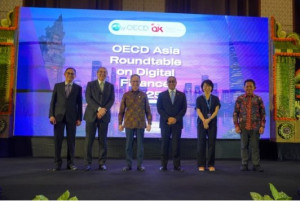
Bali hosted the OECD Asia Roundtable on Digital Finance 2025 on Monday, December 1, 2025 where Indonesia’s Financial Services Authority (OJK) and the Organization for Economic Cooperation and Development reaffirmed their commitment to promoting responsible digital finance, highlighting the need to balance innovation with financial stability and consumer protection amid rapid technological change.
OJK Chairman Mahendra Siregar noted that the regulator must adapt to the fast-developing digital industry and evolving technologies.
“With the rapid growth of technology and Artificial Intelligence (AI), it is important for us to share policy perspectives and build a regulatory framework that encourages innovation while maintaining financial stability and consumer protection,” he said.
Mahendra cited that OJK has laid the groundwork for ethical AI governance in the financial sector. In 2023, the authority introduced the Code of Ethics Guidelines on Responsible and Trustworthy AI for fintech operators, ensuring the use of AI remains fair, accountable, and beneficial. In April 2025, OJK also issued the Indonesian Banking Artificial Intelligence Governance, strengthening risk management and oversight of AI models in banks.
He added that OJK is currently advancing tokenization initiatives through a regulatory sandbox, focusing on gold, bonds, and property assets. The objective is to support innovation responsibly by safeguarding consumer interests and financial system stability.
Coordinating Minister for the Economy Airlangga Hartarto said the government is building a strong foundation for AI adoption, including human capital development.
“The financial sector needs to expand AI innovation to widen access to digital banking, micro-financing, and decision-making tools for MSMEs. Technology offers more efficient solutions, and OECD’s support helps Indonesia align national regulations with global standards,” he said.
Carmine Di Noia, OECD’s Director of Financial and Enterprise Affairs, emphasized Asia’s leading role in digital finance innovation and expressed appreciation for the partnership with OJK.
“Asia is at the forefront of digital financial transformation. Collaboration such as this is essential to ensure innovation advances responsibly while enhancing efficiency, inclusion, and public trust,” he said.
During the event, OJK and OECD launched the OECD Report on Artificial Intelligence in Asia’s Financial Sector and the Guidelines for Responsible and Trustworthy AI in Financial Technology, reinforcing alignment with international best practices.
The cooperation also supports Indonesia’s accession process to become a full OECD member. OJK’s engagement has grown more significant as the country holds a strategic position in the G20 and manages an integrated financial supervision framework. The collaboration is backed by a Memorandum of Understanding first signed several years ago and renewed in 2021.
Mahendra said the forum provides a key opportunity for regional and global alignment.
“Through this roundtable, we can exchange experiences, develop best practices, and build policy frameworks that enable digital finance innovation to drive growth and financial inclusion while collectively managing risks,” he said.
The first day concluded with a panel discussion on AI regulation and balancing innovation with oversight in digital asset markets. OJK’s Head of Financial Technology Innovation and Digital Asset Supervision, Hasan Fawzi, opened the discussion on digital assets, highlighting rapid market expansion in Indonesia.
“While AI reshapes the intelligence behind financial services, digital assets redefine the nature of assets and the infrastructure for their exchange,” he remarked.
More than 40 representatives from regulators, global industry players, and experts attended the event. Discussions continued on the second day, including an in-depth session on asset tokenization and its implications for market development.
link