Emerging Sub-Segments Transforming the Industrial Robot
Industrial Robot Battery Market
The industrial robot battery market is on the brink of significant expansion driven by rapid advancements in robotics and automation technologies. As industries increasingly adopt collaborative and automated systems, the demand for efficient and durable battery solutions tailored for these robots is rising sharply. Let’s explore the current market size, leading companies, driving factors, emerging trends, and key segments shaping this dynamic industry.
Projected Growth Trajectory of the Industrial Robot Battery Market
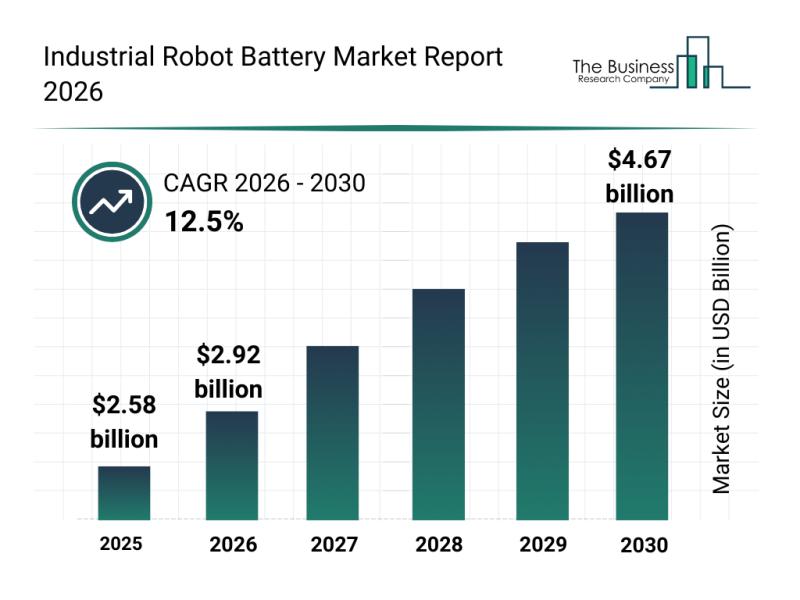
The industrial robot battery market is forecasted to grow substantially, reaching a value of $4.67 billion by 2030. This represents a strong compound annual growth rate (CAGR) of 12.5%. The expansion during this period is fueled by several factors, including the rising use of collaborative robots (cobots), the acceleration of e-commerce and warehouse automation, growth in advanced manufacturing facilities, innovations in solid-state and high-capacity batteries, and the integration of batteries with predictive maintenance and smart factory technologies. Key trends set to influence the market include the development of batteries with higher energy density, improved cycle life and durability, designs capable of withstanding harsh environments, modular and scalable battery systems for robots, and smarter battery management technologies.
Download a free sample of the industrial robot battery market report:
https://www.thebusinessresearchcompany.com/sample.aspx?id=29804&type=smp
Prominent Companies Leading the Industrial Robot Battery Market
The competitive landscape features several influential players advancing the industrial robot battery sector. Notable companies include TotalEnergies SE, Tesla Inc., BYD Company Limited, Hitachi Ltd., Panasonic Holdings Corporation, Contemporary ere*x Technology Co. Limited (CATL), LG Chem Ltd., ABB Ltd., Samsung SDI Co. Ltd., Wanxiang Group Corporation, FANUC Corporation, Yaskawa Electric Corporation, Exide Technologies LLC, Stäubli International AG, VARTA AG, Ultralife Corporation, Hangzhou Iplusmobot Technology Co. Ltd., Bentork Motion Systems Co. Ltd., and Artek Energy Solutions Pvt. Ltd.
A strategic collaboration was announced in February 2025 between HyundAI Motor Company, Kia Corporation, and Samsung SDI Co. Ltd. This partnership aims to develop next-generation, high-performance robot batteries with enhanced energy density, power output, and operational life for service robots. Samsung SDI brings its expertise in advanced lithium-ion battery technology to create compact, durable, and efficient power solutions optimized for robotic applications, reinforcing its position as a South Korea-based leader in battery manufacturing.
View the full industrial robot battery market report:
https://www.thebusinessresearchcompany.com/report/industrial-robot-battery-global-market-report
Key Drivers Advancing Growth in the Industrial Robot Battery Sector
Demand for customized battery systems with extended lifespan, rapid charging capability, and higher energy efficiency is a significant driver in this market. These features are critical to ensuring continuous robotic operations and meeting the growing automation needs across various industrial sectors.
The importance of fast-charging technology cannot be overstated, as it allows batteries to quickly regain power by optimizing energy transfer while maintaining safety and performance standards. For instance, in July 2025, Electrovaya Inc., a Canadian battery technology company, launched several battery system products designed for new robotic vehicle platforms. These platforms, developed with three leading OEMs in the US and Japan, target applications such as material handling and surveillance, offering long run times, prolonged life cycles, and rapid wireless charging to support 24/7 operations. This initiative highlights Electrovaya’s strategic commitment to the robotics market by leveraging its expertise in battery safety, durability, and performance, with initial deliveries starting in 2025 and broader commercial rollout planned for 2026.
Emerging Trends Unlocking New Opportunities in the Industrial Robot Battery Market
Industry players are focusing on creating advanced battery solutions that not only enhance performance but also cater to specific robotic platform needs. This includes improvements in battery chemistry, design, and integration with intelligent systems for predictive maintenance and efficiency.
Moreover, there is a growing emphasis on developing batteries that can operate reliably in demanding environments, with modular designs that allow scalability and customization. Such innovations are helping robot manufacturers meet increasingly complex application requirements across sectors such as manufacturing, logistics, healthcare, and aerospace.
Breakdown of Market Segments in the Industrial Robot Battery Industry
The industrial robot battery market is segmented into several categories:
1) Battery Type: Lithium-Ion Batteries, Nickel-Metal Hydride Batteries, Lead-Acid Batteries, Sodium-Ion Batteries, and Other Battery Types.
2) Robot Type: Articulated Robots, Selective Compliance Articulated Robot Arm (SCARA) Robots, Delta Robots, Collaborative Robots (Cobots), and Mobile Robots.
3) Capacity: Below 1,000 mAh, 1,000 mAh to 5,000 mAh, 5,000 mAh to 10,000 mAh, and Above 10,000 mAh.
4) Application: Welding, Material Handling, Painting, Palletizing, Inspection and Quality Control.
5) End-Use Industry: Manufacturing, Logistics and Warehousing, Automotive, Electronics, Food and Beverage, Healthcare, Aerospace.
Further subcategories include:
– For Lithium-Ion Batteries: Nickel Manganese Cobalt (NMC), Lithium Iron Phosphate (LFP or LiFePO4), Nickel Cobalt Aluminum (NCA), Lithium Titanate Oxide (LTO), high-energy and high-power cells, cylindrical, prismatic, pouch cells, and module-level pack configurations.
– For Nickel-Metal Hydride Batteries (NiMH): Standard cylindrical cells (AA/AAA), prismatic industrial cells, high-capacity, low-self-discharge, hybrid/rapid-charge NiMH, and module or pack assemblies.
– For Lead-Acid Batteries: Flooded (wet), Valve Regulated Lead-Acid (VRLA), Absorbent Glass Mat (AGM), gel lead-acid, enhanced flooded battery (EFB), tubular or OpzS deep-cycle, starter, and deep-cycle industrial packs.
– For Sodium-Ion Batteries: Layered-oxide cathode, polyanionic (NASICON-type), Prussian-blue analogue cathode, aqueous, solid-state, and available in cylindrical, prismatic, or pouch formats both at cell and pack levels.
– Other battery types: Lithium-sulfur (Li-S), solid-state batteries, flow batteries, zinc-ion/zinc-air, aluminum-ion, metal-air, supercapacitors/ultracapacitors, and fuel-cell (hydrogen) hybrid modules.
This detailed segmentation helps identify the most significant areas within the industrial robot battery market and supports targeted strategies for growth and innovation.
Reach out to us:
The Business Research Company: https://www.thebusinessresearchcompany.com/,
Americas +1 310-496-7795,
Europe +44 7882 955267,
Asia & Others +44 7882 955267 & +91 8897263534,
Email us at [email protected].
Follow Us On:
LinkedIn: https://in.linkedin.com/company/the-business-research-company,
Twitter: https://twitter.com/tbrc_info,
YouTube: https://www.youtube.com/channel/UC24_fI0rV8cR5DxlCpgmyFQ
Learn More About The Business Research Company
With over 17500+ reports from 27 industries covering 60+ geographies, The Business Research Company has built a reputation for offering comprehensive, data-rich research and insights. Armed with 1,500,000 datasets, the optimistic contribution of in-depth secondary research, and unique insights from industry leaders, you can get the information you need to stay ahead.Our flagship product, the Global Market Model (GMM), is a premier market intelligence platform delivering comprehensive and updated forecasts to support informed decision-making.
This release was published on openPR.
link