Fintech empowerment and the new-quality productivity of enterprises: empirical evidence from Chinese listed companies
Literature review
New-Quality Productivity (NQP)
Since the concept of NQP was introduced, the academic community has extensively explored it, with research falling primarily into three categories: (1) The first is theoretical foundations. This category delves into the core concept, fundamental characteristics, and measurement indicators of NQP (Liu, 2024). Lin et al. (2024) reported that NQP represents a new stage of development in which productivity can achieve a significant increase in quantity or quality. Scholars analyze NQP from dimensions such as its essence, “novelty” and “quality”, positing that NQP is inherently a form of green productivity and a catalyst for sustainable development. Existing studies measure NQP development at the macro (regional) and micro (firm) levels, focusing on labor, capital, technology, production organization, and data. NQP integrates elements such as technological innovation, green industrial transformation and upgrading, and human capital development (Liu and Li, 2025), indicating that the economic development model is shifting in a more sustainable, innovation-driven and quality-oriented direction. Yu and Zhang (2024) measured the development level of NQP in European countries from the perspective of digitalization and green synergy. Zhang et al. (2024) analyzed the coordinated development of NQP and manufacturing carbon emission efficiency at the provincial level in China using a coupled coordination model based on the essence of NQP. (2) The second category is economic and social outcomes. Research highlights the macroeconomic benefits of NQP development. For instance, Jia et al. (2024) argued that it fosters high-quality regional development. At the firm level, Yue et al. (2024) reported that NQP can significantly enhance environmental innovation. Liu and He (2024) pointed out that NQP plays a key role in promoting the high-quality development of manufacturing through coordinated industrial agglomeration. (3) The third category is drivers of NQP development. The key factors propelling NQP include industrial agglomeration, digital inclusive finance, and digital transformation (Liu and He, 2024). As a critical tool for environmental improvement and sustainable development, green finance has also garnered significant scholarly attention (Ahmed et al., 2024). Wang et al. (2025) reported that the implementation of the new environmental protection law increased the production costs of heavily polluting enterprises, thus reducing the level of enterprise NQP.
Fintech and New-Quality Productivity (NQP)
With respect to research related to fintech, existing scholarship can be summarized into three key areas: (1) The first is corporate innovation. Fintech development significantly facilitates firm innovation (Ding et al., 2022; Dong and Yu, 2023). Huang and Ma (2024) noted that fintech has improved the innovation level of enterprises through mechanisms such as preloan inspections, postloan supervision, and expected return effects. In recent years, scholars have gradually focused on the relationship between fintech and corporate green innovation. Tan et al. 2023a, 2023b examined the impact of fintech on corporate green innovation from the perspectives of credit resource allocation and external supervision and found that fintech has a significant promoting effect on corporate green innovation. (2) The second area is enterprise total factor productivity. Li et al. (2025) analyzed the impact of fintech development on the overall productivity of enterprises and found that fintech can motivate enterprises to improve their total factor productivity. Similar conclusions can also be found in Wang et al. (2024) and Liu et al. (2024). (3) The third area is corporate ESG performance. With the government’s increasing emphasis on green development, some scholars have begun to explore the relationship between fintech and corporate ESG performance. Liu et al. (2025) reported that fintech can enhance a company’s ESG performance by breaking down information barriers, optimizing investment structures, and promoting green technology innovation. Ding et al. (2024) also found that fintech can enhance a company’s ESG performance, but the mechanism of action is mainly reflected in two aspects: reducing equity costs and increasing social attention.
Innovation and green development are hallmarks of NQP. However, innovation is characterized by high investment and high uncertainty, leading to high financing costs and difficulty in transitioning to new productivity for enterprises. In China, bank credit is the primary source of external financing for enterprises, and developing new productivity requires sufficient financing resources. Finance can effectively influence enterprises’ technological innovation activities (Hsu et al., 2014), which in turn affects new productivity. Fintech has significantly enhanced the risk management capabilities of commercial banks. From an information perspective, fintech can help enterprises collect comprehensive corporate information and build big data platforms, breaking the technological constraints of traditional financial services (Tan et al., 2023a, 2023b; Jia, 2024). From a risk management perspective, the application of fintech can help financial institutions identify potential risks and violations by enterprises, thus reducing moral hazard and credit default rates. Fintech’s advantages in information provision and risk management may alleviate financing pressure on enterprises, thus positively impacting the development of NQP. However, existing research has not yet provided a clear answer as to whether fintech can promote the development of NQP in enterprises. The literature review reveals that scholars have extensively explored the relationship between the development of fintech and corporate behavior. This study addresses the gap in research noted above by examining the theoretical pathways through which fintech affects corporate NQP. We further conduct an impact assessment based on data on listed companies and conduct mechanism testing based on three dimensions: pre-financing, post-funding supervision, and corporate green innovation. This study not only enriches the literature on the microlevel effects of fintech development but also provides a theoretical foundation for accelerating NQP growth in enterprises.
Theoretical analysis and research hypotheses
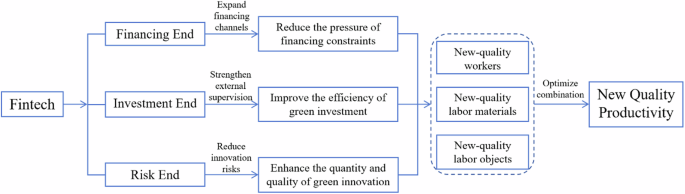
The essence of NQP lies in the efficient integration of the labor force, labor materials, and labor objects. It is a systematic construct based on the composition, structure, and function of its elements (Huang and Sheng, 2024). To increase the level of NQP, reliance on a single entity alone is insufficient; rather, it necessitates the collaborative efforts of all market entities. The theoretical mechanism through which fintech promotes the development of NQP in enterprises is depicted in Fig. 1. First, fintech can mitigate the information asymmetry between banks and enterprises, thus enhancing the efficiency of financial services. In the traditional financial credit market, banks struggle to access comprehensive information about borrowing enterprises. This difficulty results in inefficiencies both in the pre-allocation of resources and in post-credit supervision. However, the evolution of fintech has led to a transformation in the financial service model, enabling positive interactions between banks and enterprises. Financial institutions leverage fintech approaches such as data mining, deep learning, and intelligent finance to precisely assess the asset value and operational risks of enterprises. Doing so not only bolsters their ability to differentiate among enterprises but also reduces the credit risks faced by financial institutions. By avoiding the allocation of financial resources to enterprises with low credit ratings and consistently poor business performance, fintech contributes to improving the efficiency of credit resource allocation (Lee et al., 2019). For enterprises, the lessening of information asymmetry also fosters greater trust from financial institutions, streamlines their financing channels, and aids them in securing credit resources to meet the requirements of expanding production scales and conducting green technology R&D. Consequently, abundant production factors accumulate for the development of NQP (Fuster et al., 2019). Second, the development of fintech has significantly enhanced the efficiency of government regulation. On the one hand, fintech employs large model data analysis techniques to process vast amounts of unstructured information, yielding data with finer granularity and higher frequency. The government can utilize fintech to strengthen its oversight of financial institutions’ allocation of financial resources and enterprises’ utilization of these resources, thus reducing systemic risk (Abikoye et al., 2024). On the other hand, the government can also rely on fintech to identify enterprises with robust innovation capabilities and high-level green development. By providing these enterprises with support in the form of R&D subsidies, tax incentives, and preferential financial resource allocation, the government helps lower their innovation costs and risks. This in turn heightens their enthusiasm for green transformation, facilitating an improvement in their NQP levels. Based on the analysis above, the following hypothesis is proposed.

Theoretical analysis framework of how fintech impacts NQP in enterprises.
H1: The advancement of fintech can promote the development of NQP in enterprises.
The evolution of fintech enables financial credit institutions to share emerging technologies. This technology sharing reduces the cost of gathering relevant information from collateral-deficient enterprises, thus lessening the financing constraints that these enterprises face. As a result, enterprises are incentivized to allocate more resources to the distribution of NQP factors, fostering the development of NQP within enterprises. Huang et al. (2018) reported that Ant Financial employs nonfinancial information to facilitate loan approval. This emerging fintech not only increases the information transparency between banks and enterprises but also improves the quality of financial services, further propelling the growth of microenterprise entities. Lin et al. (2013) posited that social network information related to borrowers can assist them in obtaining loans more effortlessly and mitigate financing hardships. Evidently, fintech can effectively mitigate the information asymmetry between banks and enterprises. First, the progress of fintech can accelerate loan approval and alleviate the financing constraints of enterprises. Scholars have noted that with the advancement of fintech, the average loan approval speed has increased by 20% without increasing loan risk (Fuster et al., 2019). By relying on loan review methods such as big data and artificial intelligence, fintech can curtail the scope for human interference and decrease the rent-seeking costs that enterprises incur when they obtain loans. Fintech enables commercial banks and other financial institutions to deeply mine large amounts of standardized and nonstandardized data, assess corporate credit risk, and match credit resources with their funding needs, providing a solid guarantee for the security of credit funds. Fintech reduces the information asymmetry between banks and businesses, offering financing scales, costs, and terms that better meet their innovation needs while also reducing restrictive clauses and interest rate spreads in loan contracts (Giometti and Pietrosanti, 2022), thus minimizing the pressure of financing constraints on businesses. Fintech also reduces the credit supervision costs of banks and other financial institutions and improves the efficiency of credit resource allocation (Jia, 2024), thus providing the necessary conditions for businesses to develop NQP. Second, the development of fintech has broadened external financing channels. In the traditional financial credit market, financial institutions place significant emphasis on enterprises’ collateral assets, considering them a crucial determinant for lending. However, this financial service model may prevent innovative enterprises that lack collateral from securing loans, which is detrimental to the development of their NQP. Through technologies such as knowledge graphs and neural networks, fintech helps lower the entry barriers to financial markets and extends the reach of financial services (Kou and Lu, 2025). Empowered by fintech, borrowing companies have more diversified financing channels and significantly reduced financing costs (Allen et al., 2023). Based on the “profit increase–innovation growth” theoretical framework, lower financing costs for companies are conducive to increasing their profits, thus increasing their motivation to innovate and develop NQP (Aghion et al., 2024). Therefore, the rapid increase in fintech development can not only supply enterprises with ample credit resources but also reduce their financing costs, spurring enterprises to allocate more resources to innovation and sustainable development initiatives. Therefore, the following hypothesis is formulated.
H2: Fintech reduces enterprises’ financing costs, alleviates their financing constraints, and thus promotes the development of NQP.
The advancement of fintech not only broadens enterprises’ external financing channels and reduces their financing costs but also fully realizes the supervisory function over financial resource allocation. This in turn encourages enterprises to enhance their green investment efficiency. Certain studies have indicated that upon obtaining green credit resources from financial institutions, enterprises may not direct these funds toward green production activities. Additionally, banks and other financial institutions often lack effective oversight of enterprises’ fund utilization, leading to low efficiency in financial resource allocation and green investment by enterprises (Tan et al., 2023a, 2023b). A company’s investment efficiency significantly reflects its resource utilization level; in particular, green investment efficiency can better mirror the importance that enterprises attach to green environmental protection projects and their efficiency in allocating green financial resources (Liao et al., 2024). According to monitoring theory, banks can collect and process private information more efficiently and at a lower cost than individual investors can, thus curbing adverse selection and moral hazard arising from information asymmetry. Leveraging big data analysis, fintech provides a wealth of information about business entities. This information encompasses not only production and operational data but also environmental governance-related information. The development of fintech offers technical support for comprehensive supervision by banks and other financial institutions (Abikoye et al., 2024). Commercial banks and other financial institutions can rely on financial technology to monitor the use of corporate loan funds in real time, which can encourage companies to use loan funds for green investment projects and continuously improve the efficiency of corporate capital use and green investment. If an enterprise fails to use funds as regulated, it will face more stringent conditions during subsequent financing, thus increasing its financing costs. In addition, financial institutions rely on financial technology to use industrial supply chain data for customer access and risk management, establish an ecological business model that combines industry and finance, and provide enterprises with comprehensive financial services such as treasury management and smart operations. This can further enhance banks’ supervision capabilities over enterprises, thus reducing corporate agency costs, improving corporate investment efficiency, and driving corporate technological innovation and NQP. Consequently, fintech strengthens financial institutions’ supervision over enterprises’ fund use, effectively preventing the diversion of green project funds to other activities. It encourages enterprises to increase their green project investment and to continuously improve their green investment efficiency. Moreover, improvements in green investment efficiency within enterprises can expedite the optimization and integration of various new-quality production factors. Based on the analysis above, the following hypothesis is proposed.
H3: The advancement of fintech enhances the green investment efficiency of enterprises, thus promoting the development of NQP.
In the current drive for high-quality economic development, enterprises need to constantly increase their green innovation capabilities to succeed in intense market competition. However, innovation activities are highly uncertain and are easily hampered by financing constraints, which dampen enterprises’ enthusiasm for innovation (Tian, 2025). Green innovation projects typically demand substantial funding, offer a low return on investment, and are more reliant on financing. In such circumstances, fintech exerts a more potent promoting effect on corporate green innovation. First, by leveraging advanced technologies, fintech comprehensively improves the efficiency of credit allocation across the entire credit chain, covering pre-credit evaluation and post-loan supervision. It accelerates the disbursement of credit funds, thus reducing enterprises’ financing costs and stimulating their enthusiasm for green innovation (Ding et al., 2022). Second, the development of fintech contributes to improving the efficacy of the government’s innovation incentive policies. Historically, when implementing these policies, the government has lacked sufficient enterprise-related information and the means to discern the merits of innovation projects. As a result, it has been able to adopt only a broad-brush “flood-irrigation” approach. Through large model technology, fintech can conduct in-depth analyses of enterprise characteristics. Such analyses enable the government to identify truly innovative enterprises, after which tax subsidy policies can be employed to ease enterprises’ financing burdens and heighten their enthusiasm for green innovation. Finally, fintech also aids the government in strengthening the post-implementation tracking of innovative projects. It curbs enterprises’ speculative behavior, improves credit supervision efficiency, promotes the execution of green innovation projects, continuously enhances the effectiveness of innovation incentive policies, and ultimately increases the level of corporate green innovation (Dong and Yu, 2023). The analysis above reveals that fintech development can elevate enterprises’ innovation levels by improving financing efficiency, increasing the transparency of green funds, and strengthening supervision. The core of NQP lies in green productivity, which is spearheaded by technological innovation to achieve crucial technological breakthroughs (Shen et al., 2022). Corporate green innovation provides the intrinsic impetus for elevating the level of NQP. Consequently, this paper posits the following hypothesis.
H4: The development of fintech spurs the development of NQP by increasing the level of green innovation in enterprises.
link