Global Smart Eye-Tracking Medical Devices Market Size Reaches
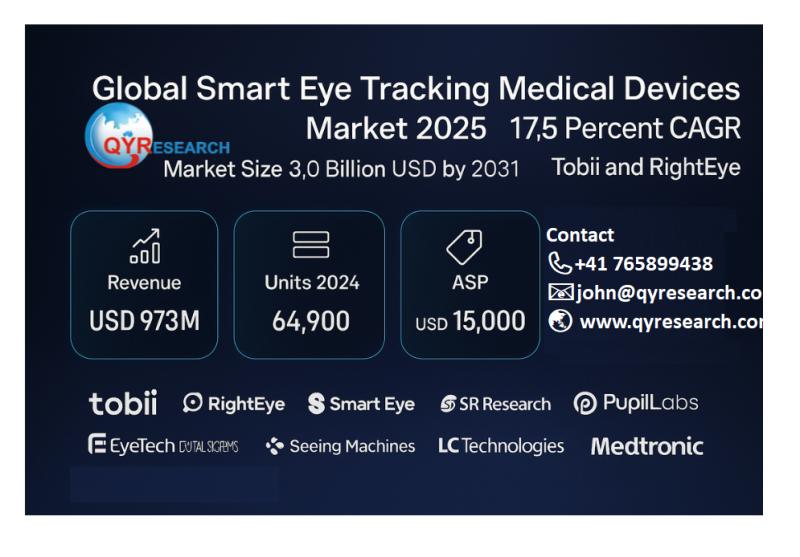
The global Smart Eye-Tracking Medical Devices market has entered a stage of accelerated clinical adoption and product diversification. According to QYResearch 2025 Global Smart Eye-Tracking Medical Devices Market Research Report, the market was valued at US$973 million in 2024 and is projected to reach US$3,009 million by 2031, growing at a CAGR of 17.5% from 2025 to 2031. Global output in 2024 reached approximately 64,900 units, with an average price of about US$15,000 per unit. These medical devices integrate advanced eye-tracking sensors and artificial intelligence algorithms to assess neurological function, support disease diagnosis, and enhance rehabilitation and communication for patients with severe motor or cognitive impairments.
Get Full PDF Sample Copy of Report: (Including Full TOC, List of Tables & Figures, Chart) https://www.qyresearch.com/sample/5045939
Leading Companies
Tobii
Smart Eye
SR Research
Pupil Labs
EyeTech Digital Systems
Gazepoint
Ergoneers
EyeLink
Seeing Machines
iMotions
NeuroSync
Eyeware
Conduent
RightEye
LC Technologies
Zebra Medical Vision
Biopac Systems
Cognixion
Xperi
SensoMotoric Instruments
Oblong Industries
Medtronic
Product Classification
Diagnostic Eye-Tracking Devices
Rehabilitation Eye-Tracking Devices
Research-Oriented Eye-Tracking Devices
Others
Application Segments
Neurological Disorder Diagnosis
Cognitive Impairment Assessment
Ophthalmologic Function Testing
Others
Market Data and Unit Economics
• 2024 Market Value: US$973 million
• Forecast (2031): US$3,009 million
• CAGR (2025-2031): 17.5%
• Global Output (2024): 64,900 units
• Average Selling Price (2024): US$15,000
Based on current cost structures from leading manufacturers, the average production cost per unit in 2025 is approximately US$5,400, generating an average gross profit of about US$9,600 per device and a gross profit margin near 64%. Top-tier producers such as Tobii report group-level gross margins of over 80% and around 64% for medical-grade device divisions, reflecting the software-heavy, high-value-added nature of the industry.
Recent Developments in 2025
In early 2025, neuroClues, a Belgium-based neurotechnology firm, received CE certification for its medical eye-tracking platform aimed at diagnosing neurological diseases. This marks one of the first fully regulated medical-grade eye-tracking systems entering European clinical practice.
Tobii announced strong financial performance in 2025 with an overall gross margin of 83% and a major pre-purchase contract worth approximately SEK100 million with Tobii Dynavox, ensuring stable component supply and revenue growth in its healthcare segment.
RightEye, a U.S. company, expanded deployment of its Sensorimotor System, an automated, insurance-reimbursable binocular vision assessment platform that runs on the FDA-cleared RightEye Vision System. The system retails around US$15,000-15,200, fully aligned with the global market’s average price level.
Meanwhile, EyeTech Digital Systems continued international expansion of its EyeOn Elite series, integrating lightweight design, long battery life, and adaptive communication features. LC Technologies maintained strong market recognition with its Eyegaze Edge platform used in clinics and assistive communication programs worldwide.
Five Representative Products
RightEye – Sensorimotor SystemTM
A fully automated binocular vision examination device providing objective eye-movement data for neurological and optometric analysis. It is FDA-cleared, reimbursable under U.S. insurance, and typically priced around US$15,100-15,200.
Tobii Dynavox – TD I-Series (I-13 / I-16)
Eye-controlled augmentative and alternative communication (AAC) systems designed for patients with ALS, cerebral palsy, and spinal cord injuries. The I-16 model is priced at approximately £7,950 in the UK, equivalent to the mid-US$10,000 range.
EyeTech Digital Systems – EyeOn Elite
An advanced 14-inch Windows-based eye-tracking device for communication and environmental control. The U.S. retail price is around US$9,500, making it one of the most mobile AAC platforms on the market.
LC Technologies – Eyegaze Edge®
An eye-controlled computing system for patients with severe disabilities. Market pricing averages US$8,000-12,500, depending on configuration and accessories.
SR Research – EyeLink 1000 Plus
A high-precision research-grade system offering up to 2000 Hz sampling rate for neurophysiological and clinical research applications. The price varies depending on configuration, generally within the tens of thousands of dollars range.
Verified Downstream Clients
Vision Source
Northern Virginia Doctors of Optometry
HCA Healthcare UK
Spaulding Rehabilitation Hospital
Shepherd Center
University Hospitals of Derby and Burton NHS Foundation Trust
Barnsley Hospital NHS Foundation Trust
ACE Centre
Guy’s and St Thomas’ NHS Foundation Trust
EYEcenter Optometric
Integrative Concussion Therapy
Comprehensive Medical Care (Metro Atlanta Pain Centers)
Bristol Centre for Enablement
Lincoln Assistive Technology Service
Market Trends
1. Regulatory Acceleration and Clinical Validation
2025 witnessed significant progress toward regulatory approval, with neuroClues’ CE certification marking the first wave of medical-grade eye-tracking devices officially entering hospital use. This trend indicates that eye-tracking is evolving from research instrumentation to diagnostic and therapeutic medical technology.
2. Integration into Reimbursement Pathways
In the U.S. and Europe, reimbursement inclusion has become a core driver. Systems such as RightEye’s Sensorimotor platform and Tobii Dynavox’s AAC devices are now covered by Medicare, Medicaid, and NHS assistive technology programs. This financial infrastructure reduces adoption barriers and supports large-scale deployment in clinical and rehabilitation facilities.
3. Pricing Segmentation and Cost Optimization
By 2025, product pricing divides into three tiers: research-grade systems exceeding US$25,000, clinical diagnostic devices averaging US$15,000-19,000, and assistive AAC platforms between US$8,000 and US$12,000. Competitive pricing and modular software packages are enabling wider accessibility across clinics and therapy centers.
4. Profit Structure Driven by Software and Analytics
The market’s profitability is increasingly shaped by data analytics and AI-driven diagnostic algorithms. Tobii’s reported 83% gross margin and 93% margin in its software integrations segment underscore how firms leveraging proprietary algorithms and subscription-based data models achieve superior profitability.
5. Automation of Clinical Workflows
Hospitals and optometry practices demand automated, repeatable oculomotor testing integrated with electronic health record systems. RightEye’s one-click testing workflow and instant visual reporting have become benchmarks for efficiency and clinical usability.
6. Expansion Beyond Ophthalmology
Applications have expanded to neurorehabilitation, vision therapy, sports performance, and education. Clinics and rehabilitation centers now use eye-tracking to evaluate concussion recovery, cognitive decline, and neuromotor coordination.
7. Convergence of Research and Clinical Applications
High-frequency devices such as SR Research’s EyeLink 1000 Plus bridge laboratory research and clinical environments. The data generated from such systems are increasingly incorporated into AI-based diagnostic algorithms used in regulated medical products.
8. Supply Chain Resilience and Strategic Procurement
The 2025 U.S. tariff policy has added volatility to component pricing. Manufacturers are responding through long-term pre-purchase contracts and multi-region sourcing. Tobii’s SEK100 million pre-purchase agreement illustrates how key suppliers hedge against tariff and logistics risk while ensuring stable production capacity.
9. Regional Market Evolution
North America leads the market due to advanced insurance coverage and clinical infrastructure. Europe follows, driven by CE-marked diagnostic adoption under MDR standards. Asia-Pacific shows strong growth potential, supported by rapid hospital digitalization and rehabilitation technology investment. Emerging regions in South America and the Middle East begin adopting portable systems for remote diagnostics and telehealth applications.
Competitive Landscape and Outlook
Major manufacturers are investing heavily in research and clinical partnerships to strengthen competitive advantage. Companies such as Tobii, Smart Eye, SR Research, and RightEye are integrating AI analytics and multi-sensor fusion into their systems to enhance diagnostic accuracy and real-time rehabilitation feedback. Consolidation through mergers, acquisitions, and technology licensing is expected to reshape the competitive hierarchy over the next five years.
Request for Pre-Order Enquiry On This Report
https://www.qyresearch.com/customize/5045939
From 2025 onward, Smart Eye-Tracking Medical Devices are set to transition from specialized research tools to mainstream clinical infrastructure across neurology, ophthalmology, and rehabilitation medicine. With strong regulatory momentum, high software-driven margins, and clear reimbursement pathways, the industry is positioned for sustainable double-digit growth through 2031.
Chapter Outline:
Chapter 1: Introduces the report scope of the report, executive summary of different market segments (by region, product type, application, etc), including the market size of each market segment, future development potential, and so on. It offers a high-level view of the current state of the market and its likely evolution in the short to mid-term, and long term.
Chapter 2: key insights, key emerging trends, etc.
Chapter 3: Manufacturers competitive analysis, detailed analysis of the product manufacturers competitive landscape, price, sales and revenue market share, latest development plan, merger, and acquisition information, etc.
Chapter 4: Provides profiles of key players, introducing the basic situation of the main companies in the market in detail, including product sales, revenue, price, gross margin, product introduction, recent development, etc.
Chapter 5 & 6: Sales, revenue of the product in regional level and country level. It provides a quantitative analysis of the market size and development potential of each region and its main countries and introduces the market development, future development prospects, market space, and market size of each country in the world.
Chapter 7: Provides the analysis of various market segments by Type, covering the market size and development potential of each market segment, to help readers find the blue ocean market in different market segments.
Chapter 8: Provides the analysis of various market segments by Application, covering the market size and development potential of each market segment, to help readers find the blue ocean market in different downstream markets.
Chapter 9: Analysis of industrial chain, including the upstream and downstream of the industry.
Chapter 10: The main points and conclusions of the report.
Contact Details
Tel: +1 626 2952 442 ; +41 765899438(Tel & Whatsapp); +86-1082945717
Email: [email protected]; [email protected]
Website: www.qyresearch.com
Related Report:
Global Smart Eye-Tracking Medical Devices Market Research Report 2025
https://www.qyresearch.com/reports/5045939/smart-eye-tracking-medical-devices
Global Smart Eye-Tracking Medical Devices Market Outlook, In Depth Analysis & Forecast to 2031
https://www.qyresearch.com/reports/5045938/smart-eye-tracking-medical-devices
2025-2031全球与中国智能眼动追踪医疗仪市场现状及未来发展趋势
https://www.qyresearch.com.cn/reports/5762336/smart-eye-tracking-medical-devices
2025年全球智能眼动追踪医疗仪行业总体规模、主要企业国内外市场占有率及排名
https://www.qyresearch.com.cn/reports/5762335/smart-eye-tracking-medical-devices
About us:
QY Research has established close partnerships with over 71,000 global leading players. With more than 20,000 industry experts worldwide, we maintain a strong global network to efficiently gather insights and raw data.
Our 36-step verification system ensures the reliability and quality of our data. With over 2 million reports, we have become the world’s largest market report vendor. Our global database spans more than 2,000 sources and covers data from most countries, including import and export details.
We have partners in over 160 countries, providing comprehensive coverage of both sales and research networks. A 90% client return rate and long-term cooperation with key partners demonstrate the high level of service and quality QY Research delivers.
More than 30 IPOs and over 5,000 global media outlets and major corporations have used our data, solidifying QY Research as a global leader in data supply. We are committed to delivering services that exceed both client and societal expectations.
This release was published on openPR.
link