Improve tube and pipe welding with artificial intelligence
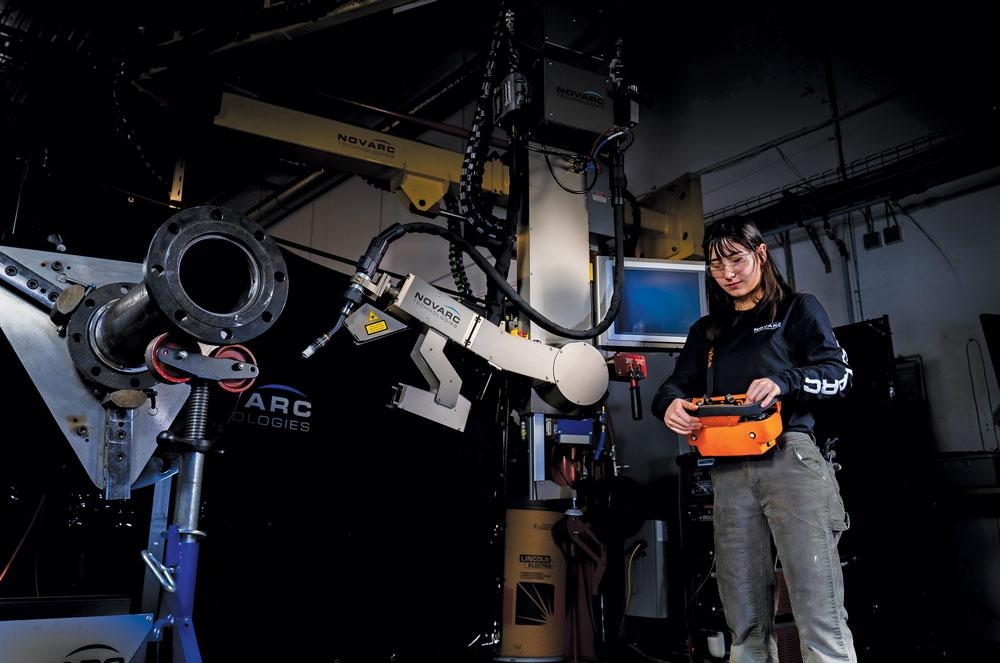
Novarc’s spool welding robot (SWR) is designed to automate pipe welding and works with a human welder to enhance productivity. Images: Novarc
Today’s manufacturing environment can be a challenging one. A lack of skilled welders makes it hard to keep up with both the labour and technical demands of customers.
For those working in the tube and pipe fabrication space, conventional industrial robots haven’t always been accessible for pipe welding applications.
To combat these challenges, Novarc engineers developed the spool welding robot (SWR), a collaborative welding robot designed to help manufacturers automate the pipe spool welding process and provide precision and dexterity to ensure welds are done correctly.
Over the last few years, Novarc has been working on artificial intelligence (AI) technology to help take its SWR to the next level. In July of this year, it launched its NovEye Autonomy Gen 2, a real-time vision processing system that constantly improves weld quality based on data collection and model enhancement to fully automate the pipe welding process. Canadian Fabricating & Welding spoke with Novarc co-founder and CEO Soroush Karimzadeh about this new technology.
CFW: What is the SWR and how does it work?
Karimzadeh: Our spool welding robot is a welding robot designed to automate pipe welding. It works with a human welder operator to enhance productivity.
However, the NovEye Autonomy release will enhance the capability of the SWR, allowing it to be set up by a welder or operator, who then can walk away post-initial setup.
The NovEye Autonomy technology is driven by AI that we have developed over many years.
Our company is a pioneer in the field of autonomous welding. We have been able to leverage the data we collected from an entire fleet of robots we’ve developed and deployed over the years.
With this date, we have developed computer vision AI models that can analyze the welding pool and respond to various changes or variations in the pipe, much like how a human welder would. By using the SWR with the NovEye Autonomy, human welders are freed up to take on different shop tasks that cannot be automated or require manpower.
CFW: What market conditions or trends make this kind of technology necessary on the shop floor?
Karimzadeh: The biggest trend is the acute shortage of human welders, which has been present in the manufacturing industry for quite some time. According to some recent estimates in the U.S., there are approximately 250,000 human welders that are missing from the economy. This comes with the backdrop of rising demand, particularly with recent U.S. legislation appropriating more infrastructure spending, which is driving more welding and fabrication projects. This demand only further exposes the skills gap and the recognition that welding automation can serve to help limit labour shortages.
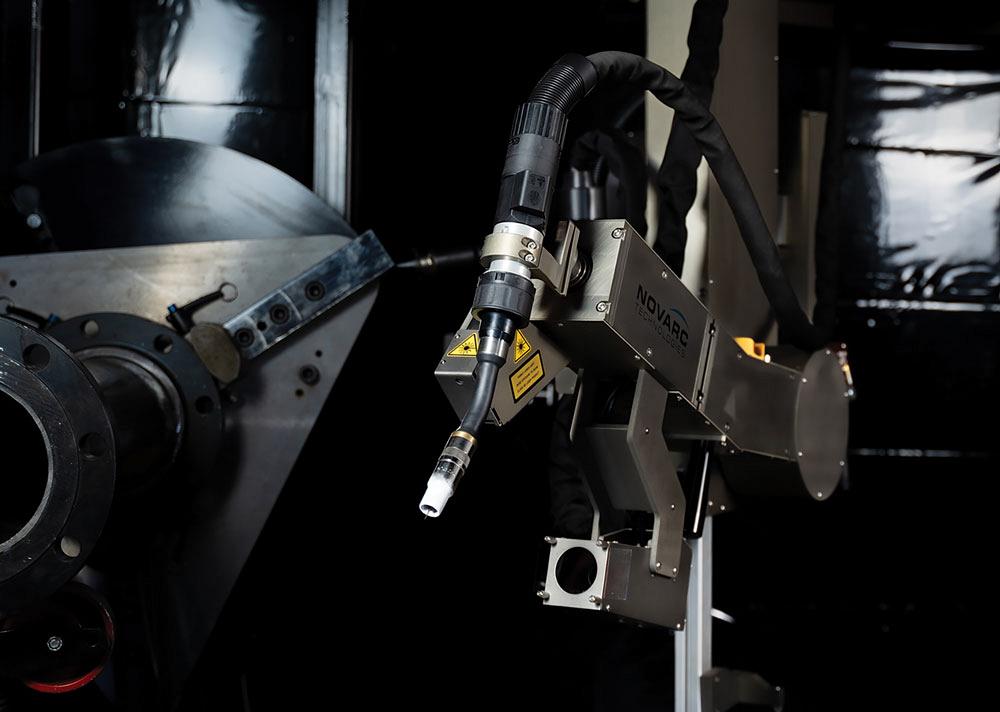
According to Soroush Karimzadeh, the pipe fabrication repair rate among North American shops is around the 3 to 5 per cent mark. The SWR brings it down to less than 1 per cent by producing consistent, high-quality welds every time.
Pipe welding is performed in almost all industrial sectors to fabricate pipe spools. For example, these components are used in oil and energy industries like LNG plants, refineries, and carbon capture plants. Pipe welding is being used in building construction, specifically pipes related to water and wastewater. It also is performed in the building of high-rises, stadiums, and even retrofitting ships. The applications are broad and very diverse.
Pipe welding as an application itself can be very difficult. The average application range of shops in North America is between 50- to 70-in. dia. More importantly, the repair rate for these shops is around 3 to 5 per cent. With the spool welding robot, which automates pipe welding, we can bring that repair rate down to less than 1 per cent. We do it by producing consistent, high-quality welds. And of course, with NovEye Autonomy, now operators can set up the pipe, hit start on the machine, and it handles the rest of it, performing as perfectly as a human could, if not better.
NovEye Autonomy is unique because for the first time, welding automation has similar intelligence, in terms of welding capability, to what human welders could do before.
CFW: How does NovEye Autonomy improve weld quality and performance?
Karimzadeh: With NovEye Autonomy, there is no need for a human operator even to run the SWR. So, for example, if a fabricator is currently producing 6,000 welds per year with 2 to 3 per cent repair rates, you’re likely spending around $180,000 per year in repairs. By reducing that repair rate to be less than 1 per cent, fabricators can put those costs back into the bottom line and support the business to get to the next stage of growth.
NovEye Autonomy is an AI machine learning real-time vision processing system that constantly improves welds based on data collection and model enhancement. It gets smarter as it continuously improves through a terabyte-scale library of welding videos, ensuring precision and reliability.
The software is embedded in the control system of the cobot and controls the weld pool in the same way a human welder would, allowing the robot to take over more repetitive welds to be delegated to the robot. The autonomous welding process enables uninterrupted welding due to the multipass and multilayer autonomous welding system, which is able to handle real-world pipe fitting inconsistencies, like Hi-Lo and varying root gaps. NovEye Autonomy can immediately detect and adapt welding parameters to maintain weld integrity.
CFW: What do shops need to know to ensure that this is a good fit for them?
Karimzadeh: This product really makes sense for fabricators that are welding various sizes and thicknesses of pipe as their core operations. Novarc also is looking to partner with shops that could benefit from deploying such automation in their operations. We’re looking for shops that want to not only increase their productivity while lowering repair rates but also attract a new generation of welders.
Today’s welders may not have the same skill set or interest as the welders of past. However, they may be attracted to working with a robot or cobot, working with AI, and working in a more innovative way. That is all to say, we are looking for forward-thinking shops that are planning to recruit talent but will benefit from deploying the SWR while increasing productivity and reducing repair rates.
For new NovEye Autonomy customers, there is not going to be any additional hardware required. The SWR is equipped with enough computing power, supported by NVIDIA, to run very advanced, large machine learning models that can handle this load in real time and take on the task of pipe quality autonomously.
It is not different from robots that have been introduced to the welding industry in terms of the level of automation and ease of use.
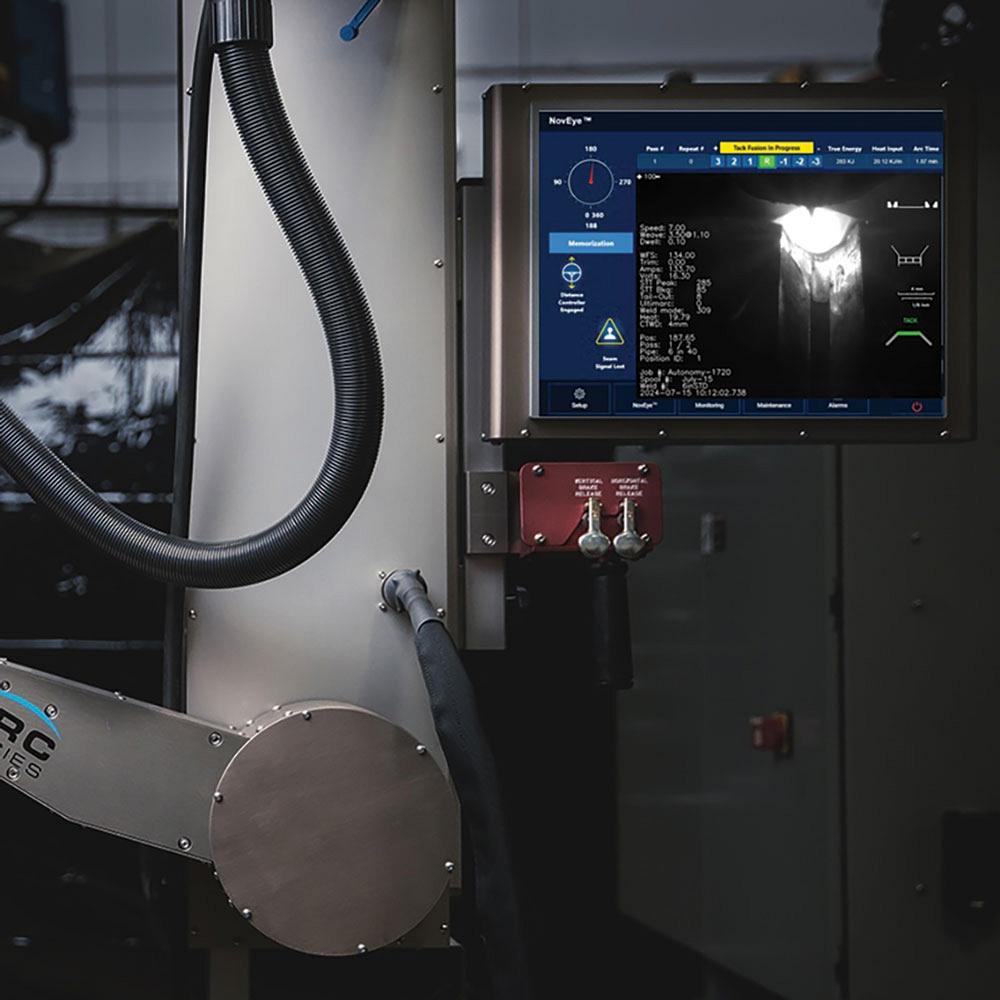
The NovEye Autonomy release will enhance the capability of Novarc’s SWR, allowing it to be set up by a welder or operator, who then can walk away after the initial setup.
A spool welding robot is very easy to use. There’s no robotic programming involved with it. The additional level of autonomy, of course, makes it even easier to deploy. This is primarily because the level of training and skills required by the operators of the SWR is significantly reduced. For the most part, automation is perceived as hard to adopt, but the SWR, with the added autonomy, we have made it very simple. Of course, this has been built on the success of more than a hundred deployments over the years.
SWR and NovEye Autonomy are specifically designed for pipe spool manufacturing, which is a high-mix, low-volume production. But that being said, in the near future, we’re planning to develop AI models that support a wider range of welding environments, including different materials and different geometries. Our primary objective today is to make sure our customers are going to be successful with their NovEye Autonomy, but we’re also working on a future generation of AI models that can do a lot more than just pipe welding, leveraging the latest and greatest in AI innovation and applying it to our welding automation solutions.
Based on our experience, we have developed change-management tools and project management tools that can help someone that is new to welding automation to able to be successful, not only in installation and training, but effectively using it in production. We have a customer success team that can work with the customers to make sure that the robots get into production as soon as possible. That’s an important piece of what it can help with.
NovArc Technologies, www.novarctech.com
link