Key factors influencing fintech adoption among Saudi banks: a conceptual framework
Fintech adoption
Fintech refers to the integration of technology into financial services and innovation (Kharrat et al., 2023). Furthermore, it is defined as a new channel that employs technological innovation to create new models for delivering financial services and products, effectively simplifying services at low cost (Mbaidin et al., 2024; Tang et al., 2024). Fintech adoption merges technology into banking operations to reduce operational costs, enhance quality, open communication channels, and introduce new financial instruments to develop the financial market based on technological innovation advantages (Oweis and Alghaswyneh, 2019; Lee et al., 2021). Moreover, Kharrat et al. (2024) found that fintech adoption enhances banking performance, including profitability, stability, and efficiency. Fintech adoption enhances both sustainability and banking performance (Siddik et al., 2024; Kaddumi et al., 2023). Lee et al. (2021) concluded that the adoption of fintech enhances banking efficiency and the effective use of technology in the banking sector in China. Thus, fintech adoption is becoming increasingly important in the financial sector, driven by development and strategies to enhance performance and competitive advantages.
Key factors driving the adoption of fintech among Saudi banks
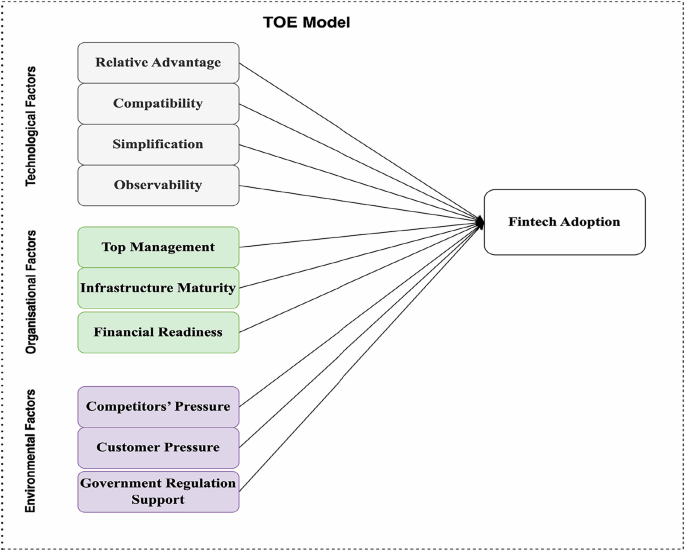
Based on the existing literature, this study proposes that the factors driving fintech adoption in Saudi Arabia include understanding technological, organisational, and external environmental factors, all of which aim to gain competitive advantages and enhance the performance of banking.
Technological factors
The adoption of modern technology by firms through the diffusion of innovation theory reflects both the capability and willingness of technology adopters to drive innovation (Rogers et al., 2014). TOE aims to elucidate the essential factors that drive technological adoption. These factors include relative advantages, compatibility, simplification, and observability, all of which significantly influence the adoption process.
Relative advantage
Refers to the degree of benefits obtained from the adoption of an innovative technology that surpasses the value produced by the existing technology within the firm (Qatawneh, 2024). Numerous researchers agree that relative advantage is a crucial factor driving innovative technology adoption (Qatawneh, 2024; Baig et al., 2019; Nguyen et al., 2022). Thus, comparing the value of existing technology to that of innovative technology adoption determines whether it is worth adopting, based on the harmony among other factors within the firm (Baig et al., 2019). Relative advantages include both tangible and intangible benefits. For instance, the adoption of fintech in the banking sector enhances reputation, reduces costs, increases customer satisfaction, heightens banking efficiency, deepens the customer information database, furthers profitability, facilitates communication, lowers the number of branches, and fosters an ecosystem supportive of sustainability (Alam et al., 2022; Baabdullah et al., 2019; Lee et al., 2021). Consequently, those applying decision-making processes must thoroughly evaluate the value derived from the adoption of new technology, considering whether the aid is tangible or intangible. The task is to prioritise adoption and integrate it into the strategic vision to enhance the value of banking, maximise profits, and gain competitive advantages.
Compatibility
Refers to the ability to integrate innovative technologies with existing ones (Zhong and Moon, 2023). Compatibility is widely considered for adaptation and operational processing, skills, culture, employees, quality, knowledge, and capabilities, making new adoption compatible with the firm’s strategies and environmental changes within the firm (Maroufkhani et al., 2020; Megahed et al., 2021). A lack of compatibility leads to disruptive operational processes, reduced quality, increased expenses, and heightened wastage and errors. Conversely, compatibility fosters smoother operations, enhanced quality, cost reduction, minimised waste and errors, and supports the adoption process. Compatibility is a crucial factor that drives innovative technology adoption based on the TOE model to enhance the adoption process based on the capability of harmony with the existing technology and the expertise of the firm in adopting the recent technology.
Simplification
Refers to the degree of simplicity in adopting innovative technology and its use in operational processes (Kallmuenzer et al., 2024; Awa et al., 2017). This involves understanding how to use technology easily in a firm’s operations and ensuring logical comprehension through employee training (Baig et al., 2019). This facilitates employee engagement and efficiency in task completion, saves time, and reduces errors. This simplification gained from innovative technology leads to increased adoption (Zhong and Moon, 2023). Awa et al. (2017) noted that simplicity reduces uncertainty risk and simplifies communication to save time for employees, leading to enhanced efficiency and increased productivity. Hence, when there is high compatibility between innovative technology and existing technology, it leads to a prominent level of simplification (Zhong and Moon, 2023).
Observability
Refers to the extent to which the features and outcomes of implementing an innovative technology are apparent (seen) to others (Rogers et al., 2014). Another aspect of observability is when another firm implements innovative technological innovation and enhances its reputation and power in the market, leading other firms to adopt that technology, which means that it becomes visible to other firms (Baig et al., 2019). Thus, Abu Bakar et al. (2019) stated that observability is one of the crucial factors driving innovative technology; further, Maroufkhani et al. (2020) indicated that decision-makers adopt innovative technology based on others’ visible results. Likewise, Hirzallah and Alshurideh (2023) elaborated on observability as an advantage, whether tangible or intangible, gained by firms adopting innovative technology. This visibility of value addition in the adopted company motivates other firms to seek similar advantages in adopting innovative technology.
Organisation factors
The TOE theory considers organisational factors as significant drivers of innovative technology adoption in firms because they reflect the characteristics, facilities, and internal resources of banking regarding the willingness and capability of banking to implement fintech. Organisational factors include top management, infrastructure maturity, and financial readiness.
Top management
Refers to the extent to which managers understand and embrace the technological capabilities of innovative technology adoption (Al-Dmour et al., 2023; Maroufkhani et al., 2020; Megahed et al., 2021). This reflects the extent to which leadership embraces changes resulting from a new business model that has been transformed by advanced technological innovations aimed at improving efficiency and reducing operational costs. When managers have the ability to understand the role of technology in a firm’s operations, it fosters a higher rate of technological adoption. Thus, top management has the power to influence the behaviour of a firm by creating strategies, mission, and culture, and supporting employees to embrace adoption (Al-Dmour et al., 2023). This involves providing training and moral support to ensure readiness to implement innovative technologies within the firm. Top management is competent in understanding the required business environment and is interested in maximising a company’s profitability to ensure long-term sustainability (Urumsah et al., 2022). Furthermore, managers are seizing opportunities, such as fintech adoption, to enhance bank operations to achieve their goals and maintain a strong position in the market.
Infrastructure maturity
Refers to IT readiness, dependent on managers’ experience regarding technology systems and human skills, enabling the efficient implementation of innovative technology, which consequently increases a firm’s efficiency through the adoption of recent technology (Al-Dmour et al., 2023; Baig et al., 2019; Gökalp et al., 2022). Furthermore, Lai et al. (2018) clarified that infrastructure maturity includes tangible aspects, such as physical technology assets, and intangible aspects, such as experiences, skills, and knowledge. Thus, a well-prepared infrastructure enhances the willingness to adopt technology, enabling effective implementation based on the value it adds to the firm, whether tangible or intangible (Baig et al., 2019; Lai et al., 2018). However, infrastructure is a barrier that complicates the adoption of innovative technology owing to the lack of solid infrastructure resources (Megahed et al., 2021). The organisation’s technological maturity provides the firm with opportunities to cope with developing new sophisticated technological innovations and other aspects that make it more flexible in obtaining the advantages of technological innovations and positioning it as a leader in implementing innovations to open new communication channels, thereby enhancing its financial performance (Al-Dmour et al., 2023). Some researchers have called for future research on infrastructure maturity, particularly in emerging markets. Hence, infrastructure maturity is considered a key factor in the organisational context of the proposed model. (Jaradat et al., 2022).
Financial readiness
Refers to the adequacy of financial allocations to adopt technology, making a firm willing to implement innovative technology that consequently enhances the value of the firm’s operations, quality, and efficiency (Baig et al., 2019; Gökalp et al., 2022). Sufficient financial resources lead a firm to implement new technological innovations, thereby increasing its flexibility by changing technological opportunities (Gupta et al., 2022). Thus, successful firms invest in technology to seize new opportunities, endorse firms in new markets, and increase profitability (Alarifi and Husain, 2023; Al-Dmour et al., 2023). Furthermore, having sufficient financial resources enables firms to hire experts and consultants for innovation, enhancing their services and products (Lai et al., 2018; Megahed et al., 2021). This financial capacity covers all expenses related to the implementation and training of a firm’s employees, which enhances the implementation of innovative technology. Financial readiness is a key factor that enhances the adoption of recent technology because it gives a firm the willingness to implement innovative technology to enhance its competitive advantage and profitability (Gupta et al., 2022).
External environment
TOE theory considers external environmental factors as crucial variables that play an essential role in a firm’s competitiveness, profitability, and overall value. Thus, understanding the significance of the external environment is vital because of its dynamic and continuous change, which provides firms with new opportunities to exploit external resources. For instance, technology is one of the primary external environmental factors that enhances efficiency, profitability, and leverage to improve a firm’s financial performance. This dynamic nature of technology is based on technological innovation, reshaping regulations, government support, and customer interest and behaviour (Sarabdeen, 2023).
Competitors’ pressure
Refers to the influence exerted on the firm by other firms in the same sector, competing based on employing technology to make the firm unique and gain advantages such as customer satisfaction, new market share, efficiency, strong branding, reputation, effectiveness, high-quality, and cost reduction to establish market leadership (Al-Dmour et al., 2023; Urumsah et al., 2022). The firm implements tactics based on competitors in the market to create strategies that meet competitor standards and enhance unique services in the market by implementing new technological channels to reach customers (Gupta et al., 2022). Increasing technology adoption by competitors focuses on gaining a relative competitive advantage. Thus, the diffusion of innovation among competitors provides new communication channels and access to new markets, thereby enhancing a firm’s market share.
Customer pressure
Arises from the demand for products and services delivered through technological innovations, compelling firms to adopt innovative technologies to meet customer expectations and enhance satisfaction (Baig et al., 2019; Urumsah et al., 2022). Kumar and Krishnamoorthy (2020) highlighted that customer needs to expand with the adoption of innovative technology, emphasising that customer satisfaction is a top priority for firms. This drives technology to enhance customer experience, foster loyalty, and improve financial performance. The customer reshapes the firm’s resources to enhance technology adoption and, thus, the communication between the firm and customer via technological innovation (Urumsah et al., 2022; Broby, 2021). Therefore, customer pressure depends on industry characteristics. However, the banking sector is extremely sensitive to customer satisfaction because customers create deposits that banks transfer into assets to provide loans and generate profits (Broby, 2021; Khan et al., 2021; Megahed et al., 2021). Consequently, banks provide ideal services and financial products to enhance customer satisfaction, aiming to attract more customers and increase banking liquidity based on the volume of deposits, thereby increasing profitability (Alkhawaldeh et al., 2023).
Government regulation support
Refers to the policies established by the government as guidelines to define the rights of companies and customers while outlining firms’ responsibilities to comply with these regulations and avoid legal violations (Sarabdeen, 2023; Baig et al., 2019; Maroufkhani et al., 2020). This can either encourage or discourage the adoption of innovative technologies (Maroufkhani et al., 2020). Furthermore, the banking industry is highly regulated to safeguard customer rights and minimise the industry’s exposure to high risks. Therefore, some studies refer to the banking sector as a late-implementation technology compared to other sectors, based on strict regulations to prevent them from being implemented; however, the banking sector is eager to take advantage of the technology to reduce financial transaction costs and asymmetric information (Khalid and Kunhibava, 2021; Khan et al., 2021). Further, the government supports such as funding, training, and flexible regulation to encourage technological innovation and enhance the financial sector (Nguyen et al., 2022). According to Gupta et al. (2022), government regulatory support is one of the variables governing technology adoption in the financial sector. Government regulation is an essential factor in enhancing technology adoption because although a company may have all elements, including technological, organisational, and environmental factors pushing it to adopt technology, government regulation may prevent or disallow them, making it impossible for the company to adopt.
Barriers to fintech adoption in Saudi banks
Despite the numerous advantages of fintech adoption, banks in emerging markets face critical challenges, such as data security risks, limited IT infrastructure, and regulatory constraints. Cybersecurity concerns have slowed the adoption of fintech solutions because banks must ensure compliance with financial regulations while safeguarding customer data (Nguyen et al., 2022; Tang et al., 2024). Hence, Saudi banks face challenges in infrastructure readiness, including the ongoing technological revolution, compatibility of existing systems with innovative technologies and regulatory standards, and the transition from traditional banking to digitalisation (Sarabdeen, 2023). Furthermore, competitors pose significant threats to traditional banking by introducing new financial models, such as fintech startups, P2P lending, digital banking, and e-wallet services. The economic outlook suggests that leveraging technological innovations and resource optimisation will help Saudi banks raise SAR 4.553 billion in 2030. This advancement requires managers to have a deep understanding of the financial environment, particularly in developing countries where the banking sector is being transformed by the technology revolution.
link