Middle East Smart Medical Devices Market Size Report, 2033
Middle East Smart Medical Devices Market Summary
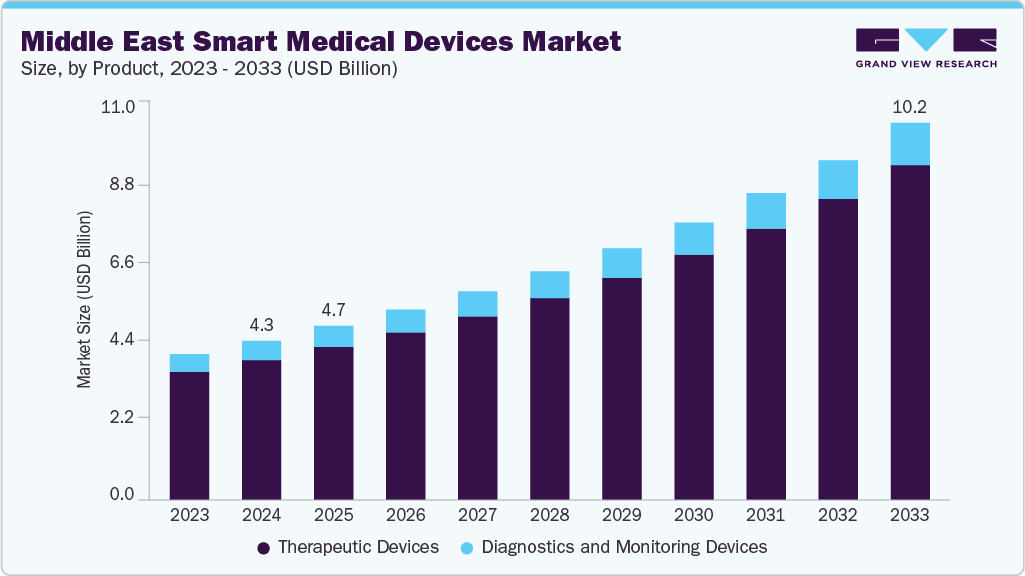
The Middle East smart medical devices market size was estimated at USD 4.32 billion in 2024 and is projected to reach USD 10.23 billion by 2033, growing at a CAGR of 10.16% from 2025 to 2033. Technological advancements, the rising prevalence of chronic diseases, and the increasing integration of EHR with medical devices contribute to the market growth.
Key Market Trends & Insights
- By product, the therapeutic devices segment led the market with a share of over 87.9% in 2024.
- By distribution, pharmacies emerged as the leading distribution segment in 2024 and accounted for 38.34% of the market share.
- By end use, the hospitals segment was the leading end-use segment in 2024 and accounted for 42.95% of the market share.
Market Size & Forecast
- 2024 Market Size: USD 4.32 Billion
- 2033 Projected Market Size: USD 10.23 Billion
- CAGR (2025-2033): 10.16%
The Middle East smart medical devices market is gaining significant momentum, driven by national digital health initiatives such as Saudi Vision 2030 and the UAE’s digitization efforts. These initiatives are supported by expanding 5G, IoT, and cloud infrastructure, which enable the integration of connected devices including wearables, remote monitors, and AI-enabled diagnostics into clinical and public health systems. For instance, in June 2025, the UAE-led diabetes research project was launched aboard Axiom Mission 4, where a four-member international team tested continuous glucose monitors in microgravity aboard the International Space Station, in collaboration with Abu Dhabi-based Burjeel Holdings and Axiom Space. This innovative effort underscores the region’s willingness to explore unconventional environments to validate smart medical technologies and rethink approaches to diabetic care both in space and in clinical practice.
The highest adoption rates are seen in remote patient monitoring systems and wearable medical devices, especially for chronic conditions like diabetes, cardiovascular diseases, and respiratory illnesses, which are very common across the GCC. Increasing physician readiness for digital health transformation, along with government-supported e-health interoperability frameworks, is improving the integration of smart devices into clinical workflows. Furthermore, the growing popularity of fitness and wellness wearables among younger, tech-savvy populations is further blurring the line between consumer health products and medical-grade devices. This trend, fueled by rapid healthcare digitization, makes the Middle East one of the fastest-growing regions for smart medical devices.
Market Concentration & Characteristics
The chart below illustrates the relationship between market concentration, industry characteristics, and industry participants. The x-axis represents the level of industry concentration, ranging from low to high. The y-axis represents various industry characteristics, including industry competition, impact of regulations, level of partnerships & collaborations activities, degree of innovation, and regional expansion. For instance, the Middle East smart medical devices market is slightly fragmented, with many product & service providers entering the market. The degree of innovation, the level of partnerships & collaboration activities, and the impact of regulations on the industry are high. However, the regional expansion observes moderate growth.
The degree of innovation in the Middle East smart medical devices market is moderate to high, driven by accelerating digital health transformation programs, strong government support, and rising demand for connected, technology-enabled healthcare solutions. Healthcare providers across the region are increasingly adopting wearable devices, remote patient monitoring systems, and AI-integrated diagnostic tools to improve clinical outcomes, support chronic disease management, and enhance preventive care. For instance, Glasgow-based Novosound developed a miniaturized ultrasound wearable device called Slanj that provides real-time, continuous, and cuffless blood pressure monitoring with accuracy comparable to traditional cuff devices, potentially transforming hypertension management and healthcare monitoring. This innovation was showcased at CES 2025 in January 2025.

The level of partnerships and collaboration activities among key players in the Middle East smart medical devices market is moderate, reflecting the region’s emphasis on building connected, interoperable, and scalable healthcare ecosystems. Strategic alliances between international medtech companies, regional healthcare institutions, and technology startups are helping to accelerate innovation and support the integration of advanced devices such as smart wearables, connected monitoring solutions, and digital diagnostics into clinical practice.
The impact of regulations on the Middle East smart medical devices market is high, as governments across the region implement stringent frameworks to ensure patient safety, device efficacy, and cybersecurity in connected healthcare environments. Regulatory bodies such as the UAE’s Ministry of Health and Prevention (MOHAP) and Saudi Food and Drug Authority (SFDA) are increasingly aligning with international standards like ISO 13485, IEC 60601, and GDPR to govern device quality, interoperability, and data protection.
The level of regional expansion in the Middle East smart medical devices market is moderate, supported by rising healthcare digitization initiatives and strong government investments across the Gulf Cooperation Council (GCC) countries.
Product Insights
Based on product, the therapeutic devices segment led the market with a revenue share of 87.9% in 2024 and is expected to grow the fastest during the forecast period. The increasing prevalence of chronic diseases, rising demand for minimally invasive treatments, and advances in personalized medicine are key factors driving segment growth. These smart medical devices deliver precise, targeted therapies, improving patient outcomes and reducing hospitalizations. This shift toward more efficient, patient-specific treatments is transforming healthcare delivery and supporting the adoption of innovative medical technologies.
Diagnostics and monitoring devices is anticipated to grow at a significant CAGR over the forecast period due to the increasing demand for early disease detection and personalized healthcare solutions. Technology advancements in smart hospitals, such as AI and ML, enhance diagnostic accuracy and enable real-time monitoring, allowing healthcare providers to make informed decisions and improve patient outcomes.
Distribution Channel Insights
Based on the distribution channel, pharmacies dominated the market with the largest revenue share of 38.34% in 2024. Pharmacies have become crucial distribution channels for smart medical devices owing to their enhanced accessibility. As patients increasingly seek convenient solutions for managing chronic conditions at home, pharmacies are well-positioned to fulfill this demand. By integrating smart medical devices into their offerings, pharmacies improve patient engagement and enhance medication adherence & monitoring.
The online channel is expected to grow at the fastest CAGR during the forecast period. Online platforms have made it possible for manufacturers to reach a wider audience and for customers to purchase devices online. In addition, online marketplaces, such as Medtronic’s online store, allow customers to browse and purchase devices directly from the manufacturer. This shift towards online distribution has increased accessibility and convenience for customers while reducing costs and improving supply chain efficiency.
End Use Insights
The hospital segment dominated the market with the largest revenue share in 2024. The segment’s growth can be attributed to the increasing demand for remote patient monitoring, the rising prevalence of chronic diseases, supportive regulatory frameworks for telehealth solutions, and a growing focus on personalized medicine. Moreover, devices such as wearable health monitors, smart infusion pumps, and connected imaging systems allow healthcare hospitals to gather real-time data about patient conditions. Integrating AI into these devices further amplifies their effectiveness by providing predictive analytics to identify potential complications.
Home healthcare is expected to grow the fastest from 2025 to 2033. The rising cost of hospital care, improved technology, a greater focus on remote patient monitoring, and increased telehealth integration have significantly shifted patients’ preference toward receiving treatment in home care settings rather than hospitals.

Home care segment is expected to grow fastest from 2025 to 2033. The rising cost of hospital care, improved technology, an increasing focus on remote patient monitoring, and increasing telehealth integration have significantly shifted patients’ preference to get treatment in home care settings rather than hospitals. Furthermore, market players are engaged in collaboration activities to provide advanced technologies for home care settings.
Country Insights
UAE Smart Medical Devices Market Trends
The smart medical devices market in UAE is witnessing steady growth, fueled by strong government-led digital health initiatives, rapid adoption of connected technologies, and rising demand for advanced chronic disease management solutions. For instance, in July 2024, Dexcom G7 continuous glucose monitoring system was launched in Dubai, making GluCare. Health the first clinic in the country to offer this compact and accurate device for real-time diabetes management. This development underscores the UAE’s role as an early adopter of cutting-edge smart medical technologies aimed at improving patient outcomes and enhancing personalized care.
Saudi Arabia Smart Medical Devices Market Trends
Smart medical devices market in Saudi Arabiais experiencing rapid growth, driven by significant technological advancements and government initiatives. For instance, in February 2024, Saudi Health launched a new project providing tele-electroencephalogram (EEG) services via the SEHA Virtual Hospital (SVH). This initiative allows medical officers to monitor EEG recordings 24/7 through devices directly connected to the SVH, revolutionizing remote patient care and neurological monitoring. Such developments highlight Saudi Arabia’s commitment to enhancing digital healthcare.
Key Middle East Smart Medical Devices Company Insights
The market is highly fragmented, with many small and large players operating in this space. This leads to intense competition between smaller players to sustain their position. Strategies such as new product launches and partnerships are playing a key role in propelling the market growth.
Key Middle East Smart Medical Devices Companies:
- Abbott Laboratories
- Medtronic
- Ascensia Diabetes Care
- Dexcom, Inc.
- F. Hoffmann-La Roche Ltd
- Masimo
- Dräger Group
- LifeScan, Inc.
- Garmin
- Sonova
- WS Audiology
- Demant A/S
Recent Developments
- In January 2024, Sanrai and Drive DeVilbiss Healthcare unveiled the Pulmo2 10-liter oxygen concentrator at Arab Health in Dubai, featuring energy-efficient design and robust performance for clinical settings.
Middle East Smart Medical Devices Market Report Scope
|
Report Attribute
|
Details
|
|
Market size value in 2025
|
USD 4.72 billion
|
|
Revenue forecast in 2033
|
USD 10.23 billion
|
|
Growth rate
|
CAGR of 10.16% from 2025 to 2033
|
|
Actual data
|
2021 – 2024
|
|
Forecast period
|
2025 – 2033
|
|
Quantitative units
|
Revenue in USD million/billion and CAGR from 2025 to 2033
|
|
Report coverage
|
Revenue forecast, company ranking, competitive landscape, growth factors, and trends
|
|
Segments covered
|
Product, distribution channel, end use, country
|
|
Country scope
|
Saudi Arabia; UAE; Kuwait; Qatar; Oman
|
|
Key companies profiled
|
Abbott Laboratories; Medtronic; Ascensia Diabetes Care; Dexcom, Inc.; F. Hoffmann-La Roche Ltd; Masimo; Dräger Group; LifeScan, Inc.; Garmin; Sonova; WS Audiology; Demant A/S.
|
|
Customization scope
|
Free report customization (equivalent up to 8 analysts working days) with purchase. Addition or alteration to country, & segment scope.
|
|
Pricing and purchase options
|
Avail customized purchase options to meet your exact research needs. Explore purchase options
|
Middle East Smart Medical Devices Market Report Segmentation
This report forecasts revenue growth at country levels and provides an analysis of the latest industry trends in each of the sub-segments from 2021 to 2033. For this study, Grand View Research has segmented the Middle East smart medical devices report based on product, distribution channel, end use, and country:
-
Product Outlook (Revenue, USD Million, 2021 – 2033)
-
Distribution Channel Outlook (Revenue, USD Million, 2021 – 2033)
-
End use Outlook (Revenue, USD Million, 2021 – 2033)
-
Country Outlook (Revenue, USD Million, 2021 – 2033)
-
Saudi Arabia
-
UAE
-
Kuwait
-
Qatar
-
Oman
-
Frequently Asked Questions About This Report
b. The Middle East smart medical devices market size was estimated at USD 4.32 billion in 2024 and is projected to reach USD 4.72 billion by 2025
b. The Middle East smart medical devices market is expected to grow at a compound annual growth rate of 10.16% from 2025 to 2033 to reach USD 10.23 billion by 2033.
b. Saudi Arabia dominated the market and accounted for a 33.3% share in 2024, driven by significant technological advancements and government initiatives.
b. Some key players operating in the he Middle East smart medical devices market include Abbott Laboratories, Medtronic , Ascensia Diabetes Care, Dexcom, Inc., F. Hoffmann-La Roche Ltd, Masimo, Dräger Group, LifeScan, Inc., Garmin, Sonova, WS Audiology, and Demant A/S.
b. Key factors that are driving the market growth include technological advancements in smart medical devices, the rising prevalence of chronic diseases, increasing funding for research and development and the increasing integration of EHR with medical devices. In addition, national digital health initiatives such as Saudi Vision 2030 and the UAE’s digitization efforts contribute to market growth.
link