Sci-Tech finance, digital economy and high-quality development of regional economy: empirical evidence from 273 cities in China
Sample descriptive statistics
To test for the presence of multicollinearity in the variables, the Variance Inflation Factor (VIF) test is performed; the results are presented in Table 2. The maximum VIF value of each variable is 2.165, the minimum value is 1.279, and the average VIF value is 1.680, which is much smaller than the test requirement of 10. Thus, the effect of multicollinearity can be ignored to some extent. The descriptive statistics for each variable are provided in Table 3. The maximum and minimum values of the sample data vary considerably from one variable to another, indicating a great deal of variability across regions. Notably, some values in Table 3 are negative because the control variable is logarithmic and is included in the regression.
Benchmark regression
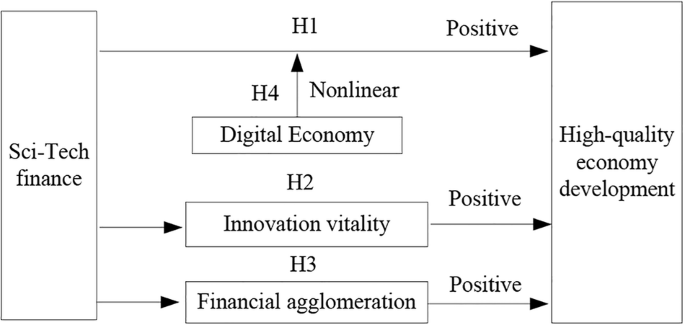
Benchmark regression models were used to rigorously appraise the relationship between Sci-Tech finance and the advancement of high-quality economic development. Table 4 details the findings, the robustness of which was evaluated using a city-based clustering approach. The analysis is segmented in this table: columns (1) and (2) center on national sample data regressions, controlling for both time and individual city effects. Column (1) presents the findings without control variables, whereas column (2) includes control variables. When both time and city influences are controlled, the regression result for the national sample data is 0.295, which is statistically significant at the 1% significance level. This finding suggests a significant correlation, in which a one-unit increase in Sci-Tech finance corresponds to a 0.295 unit increase in the index of high-quality economic development. Columns (3) to (5) present the regression results based on the subsamples of the eastern, central, and western region respectively. The regression coefficient in the eastern region is 0.199, and that in the central region is 0.2789, both of which have passed the significance test. The results showed that the impact of regional Sci-Tech finance on high-quality economic development is the greatest in the central region, followed by the eastern region, while it is not significant in the western region. The overall economic and Sci-Tech finance levels in the western region are comparatively low. Analysis based on the Gini coefficient indicates that the Gini coefficient for the Sci-Tech finance index in the western region is higher than that in the eastern region, implying significant internal disparities and pronounced polarization within the Sci-Tech finance landscape of the western region. Specifically, provincial capital cities such as Guiyang, Chengdu, Xi’an, and Lanzhou have exhibited robust development, whereas other prefecture-level cities in the western region have lagged behind in Sci-Tech finance development, resulting in substantial regional variations in the Sci-Tech finance development index. This disparity constitutes one of the key factors contributing to the insignificant regression results observed in samples from the western region. The regression results of the samples indicate that Hypothesis H1 has been verified.
Endogeneity issues
IV method test
The endogeneity problem should be fully taken into account in regression analysis. In this study, the sources of the endogeneity problem are as follows: First, there is the bias of omitted variables. Despite the thorough inclusion of various factors such as government influence, open to the outside world, and human capital, and employing both city-fixed and time-fixed effects in the analysis, there remains the possibility that certain unseen variables could affect the relationship between Sci-Tech finance and the high-quality economic development, yet are not accounted for. Another concern raised is the selection bias in the sample. Focusing on 273 prefecture-level cities, the research strives to exclude cities with missing data to mitigate this issue. However, despite efforts to compensate for minor data gaps through interpolation, the potential for sample bias occurs.
The study utilizes 1984 postal history data as an instrumental variable to test the endogeneity problem. The rationale behind this choice lies in two key observations. Historically, the postal service played a critical role in laying down telephone networks and served as a crucial channel for remittances, significantly influencing financial operations. The intertwining of financial industry development with the advent of telecommunications, due to the extensive adoption of telephones, highlights the relevance of this historical context. Additionally, the historical data on fixed-line telephone density and the scale of postal and telecommunication activities in cities have a negligible effect on the contemporary indices measuring economic quality development across these cities. Therefore, it can be considered that choosing the per capita postal and telecommunications business volume in 1984 (PTBV) as an instrumental variable meets the two requirements of instrumental variable correlation and exogeneity. Some literature also uses the lagged one period of the core explanatory variable as an instrumental variable. Since this study is panel data and PTBV is cross-sectional data, therefore, the product of PTBV and the lagged one period of the core explanatory variable is taken as the IV instrumental variable.
Table 5 demonstrates the results from applying the instrumental variable method, where column (1) presents the regression results of the first stage and column (2) displays the regression results of the second stage. The first stage shows an F-value of 23.030, exceedinging the threshold of 10. This is in line with the benchmarks set by Cragg and Donald (1993) as well as Stock and Yogo (2002). The result of the Cragg-Donald Wald F statistic is 452.70. This figure exceeds the critical value for the 10% significance level, set at 16.38, thus refuting the original hypothesis of “instrumental variables are weakly identified” (Stock and Yogo, 2002). This finding confirms the test’s requirements are satisfied. Moreover, the p value of Kleibergen-Paap rk LM statistic is 0.000, demonstrating the non-identifiable test’s results are valid. The regression coefficient in column (2) is 1.102 and passes the 1% significance test, the analysis indicates a significant and positive correlation between Sci-Tech finance and high-quality economic development, echoing the benchmark regression findings. This indicates the robustness of the results of this study.
Considering lagged effects
Considering the sustained and lagged effect of Sci-Tech finance on the high-quality economic development, this study aims to mitigate potential endogeneity concerns by regressing the explanatory variables with a one-period lag, as illustrated in Table 6. Column (1) and columns (3) accounts for time-fixed effects and individual fixed effects without incorporating control variables, while columns (2) through (4) both include control variables. It can be seen that regardless of whether the control variables are added or not, the regression results are significantly positive after lagging one period and lagging two periods of the explanatory variables. These findings emphasize the impact of Sci-Tech finance on the high-quality development of the economy has a certain sustained effect and lagged effect.
Robustness tests
Winsorization
To minimize the potential effect of data outliers, the sample data is subjected to winsorization. In the 1% winsorization, values less than the 1st percentile are replaced with the value at the 1st percentile, and values greater than the 99th percentile are replaced with the value at the 99th percentile. The results of the 1% and 5% winsorization are presented in Table 7. After controlling for time-fixed effects, city-fixed effects, and control variables, the regression coefficient with a 1% reduction was 0.355; while the regression coefficient with a 5% reduction was 0.369, displaying no significant difference from the coefficients of the original benchmark regression. The results confirm the robustness of the sample data.
Indicators of replacement variables
To further verify the reliability of the model, we propose substituting the indicators of the dependent and independent variables for regression validation. The results are summarized in Table 8. Column (1) presents the results of the recalculation by replacing one variable with the constituent indicators of the Sci-Tech finance index. Columns (2) and (3) present the results obtained after replacing the calculation methods of the sub-indices with the measurement indicators of the high-quality economic development index. By changing the explanatory variables and the explained variables, the regression coefficients remain significant, indicating that Sci-Tech finance has a significant promoting effect on high-quality economic development and is robust and reliable.
Heterogeneity analysis
To delve deeper into the effect of Sci-Tech finance on the advancement of high-quality economic development, this analysis explores the role of Sci-Tech finance through three perspectives: the level of human capital, the degree of innovation, and digital infrastructure. We utilizing Fisher’s Permutation test by self-sampling (Bootstrap) 1000 times to calculate the P value, indicating the differences in coefficient impacts across various groups, as detailed in Table 9.
First, grouping by human capital level, the regression results for different groups in Sci-Tech finance on economic development are illustrated in Table 9. The data with higher human capital levels, as presented in column (1), has a regression coefficient of 0.407, and passes the 1% significance test. In contrast, the data for groups with lower human capital, indicated in column (2), does not exhibit a significant regression coefficient. The P value for the test comparing coefficient differences across these groups stands at 0.004, meeting the criteria for the 1% significance level. This highlights a significant difference in the effect of Sci-Tech finance on high-quality economic development, dependent on the regional levels of human capital. Specifically, regions endowed with a richer human capital base exhibit a greater benefit from digital infrastructure, such as networks, in cultivating digital financial inclusion (Niu et al., 2022). The analysis confirms that areas with higher human capital levels exhibit a more significant regression coefficient than the aggregate sample, highlighting a more significant effect of Sci-Tech finance on enhancing economic quality in these regions. Conversely, in areas with low levels of human capital, the effect of Sci-Tech finance on cultivating high-quality economic growth appears negligible. This underlines the critical role human capital plays in economic excellence, necessitating increased investment in education to uplift regional human capital standards.
Secondly, in exploring the effect of Sci-Tech finance on the advancement towards high-quality economic development, a distinction is made between regions based on their innovation levels. This distinction is measured through the perspective of authorized invention patents per capita, which serve as a proxy for measuring innovation. Analysis is categorized into two cohorts, with findings detailed in Table 9. For regions classified under the high innovation tier, as presented in column (3), the regression coefficient is observed at 0.331, and statistically significant at the 5% level. Conversely, the coefficient associated with regions of lower innovation, as demonstrated in column (4), the regression coefficient for regions with low levels of innovation 0.020 but not significant. A comparison of coefficient variances between these groups yields a p value of 0.024 at a 5% significance level. This result highlights a significant difference in how Sci-Tech finance catalyzes high-quality economic progression across regions characterized by varying innovation intensities. Specifically, the significant regression coefficient in regions of high levels of innovation suggests that Sci-Tech finance plays a more critical role in cultivating high-quality economic results in these regions. This is in contrast to regions with low levels of innovation footprint, where the effect of Sci-Tech finance on economic quality is negative. This difference may be attributed to the weak Sci-Tech foundation and innovation capabilities.
Third, in analyzing the relationship between digital infrastructure and economic development, analyzes were segmented into two categories as presented in columns (5) and (6) of Table 9. The digital infrastructure index is a comprehensive index calculated by the entropy method based on the number of local data centers, the coverage rate of Internet users, the coverage rate of mobile phones and so on. Analysis of regression results indicates that the effect of Sci-Tech finance on the advancement towards a high-quality economic state is markedly more significant in zones with extensive digital infrastructure, with a coefficient of 0.355 and passes the 1% significance test. In contrast, such effect appears negligible in areas with lower digital infrastructure. The statistical test for coefficient difference between these groups underlines a significant difference, highlighted by a p value of 0.013 at the 5% significance level, thereby confirming a moderating effect of digital infrastructure on the efficacy of Sci-Tech finance in cultivating economic excellence. The observed difference in regression coefficients, favoring regions with digital infrastructure, highlights the enhanced effect of Sci-Tech finance in such locales. This phenomenon accentuates the urgency for accelerated enhancements in digital infrastructure and mobile information network accessibility. Such strategic developments are essential for catalyzing the confluence of Sci-Tech and financial sectors, thereby amplifying the role of Sci-Tech finance in elevating the standard of economic development to a higher quality.
In summary, the study of the data indicates that the effect of Sci-Tech finance on enhancing economic quality is notably more significant in regions characterized by high human capital, a high degree of innovation, and high level digital infrastructure. This highlights the necessity for a customized approach to the application of Sci-Tech finance, tailored to the specific conditions of each region. In areas where Sci-Tech finance plays a critical role in cultivating high-quality economic development, it is crucial not only to leverage its potential to guide this development effectively but also to address and bridge the gaps in regions where its effect is less significant. Accordingly, it is possible to further realize the potential of Sci-Tech finance as a where for advancing the cause of high-quality economic growth.
Analysis of the impact mechanisms
Testing strategy for mediating transmission mechanism
To further explore the mediating transmission mechanism of Sci-Tech finance on high-quality economic development, numerous studies generally adopt the three-step mediating effect model proposed by Wen and Ye (2014) to test whether the mediating effect exists and analyze the influence transmission role of the mediating variables. Specifically, the first step is to examine the impact of Scifi on Quali, as shown in formula (1); the second step is to analyze the impact of Scifi on the mediating variable \({M}_{it}\), as shown in Eq. (4); and the third step is to incorporate the mediating variables and the Scifi into the regression model simultaneously to test their impacts on Quali, as shown in Eq. (5).
$${M}_{it}={\alpha }_{0}+{\alpha }_{1}Scif{i}_{it}+{\alpha }_{2}{X}_{it}+{\mu }_{i}+{\varphi }_{t}+{\varepsilon }_{it}$$
(4)
$${Y}_{it}={\beta }_{0}+{\beta }_{1}Scif{i}_{it}+{\beta }_{2}{M}_{it}+{\beta }_{3}{X}_{it}+{\mu }_{i}+{\varphi }_{t}+{\varepsilon }_{it}$$
(5)
However, when this method is applied in economics, endogeneity issues may occur, and the mediating variables may have reverse causality (Jiang, 2022). This study adopts the following methods to overcome the shortcomings of the traditional three-step test.
First, referring to the method for addressing the endogeneity issue of Sci-Tech finance in IV method test, the mediating mechanism variables, namely, Innovit and Finagg are taken as the core explanatory variables for the analysis, and the IV method is employed to verify whether Innovit and Finagg are exogenous variables in the regression of Quali. Second, to overcome the potential endogeneity influence of the mediating variables, in contrast to the traditional analysis method that adopts the OLS benchmark regression analysis model, the 2SLS model is utilized for the regression analysis in steps (4) and (5). The specific idea is that in the 2SLS regression model of Scifi on the Quali, the influence mechanism variables are gradually incorporated to observe whether the regression coefficient of Scifi becomes larger or smaller after the addition of these mediating influence mechanism variables. If the regression coefficient of Scifi decreases after adding a mediating influence mechanism variable, it indicates that this influence mechanism variable is a positive transmission mechanism through which Scifi affects Quali. Conversely, an increase in the regression coefficient implies that the mediating influence mechanism variable is a negative transmission mechanism.
Results of mechanism testing
First, the IV method is employed to verify whether the mediating mechanism variables, namely Innovit and Finagg, are exogenous variables in the regression of Quali. Table 10 presents the results of the 2SLS regression analysis.
Analyzing Innovit as an influential mechanism variable, the F-statistic value in the first stage is 73.160, exceeding the required threshold of 10 and thus passing the test requirement. The Cragg-Donald Wald F statistic yields a value of 1626.950, surpassing the critical value of 16.38 at a 10% significance level. In addition, the p value of the Kleibergen-Paap rk LM statistic is 0.039, verifying the non-identifiable test results. The second-stage regression coefficient of Innovit is 0.564 and is significant at the 1% level, demonstrating that Innovit meets the criteria for an exogenous variable.
Analyzing Finagg as an influential mechanism variable, the first-stage F-statistic is 186.89, which also exceeds the threshold of 10 and satisfies the test requirements. The Cragg-Donald Wald F statistic results in a value of 2305.14, exceeding the critical value of 16.38 at a 10% significance level. In addition, the p value of the Kleibergen-Paap rk LM statistic is 0.093, confirming that the non-identifiable test results are valid. The second-stage regression coefficient is 17.219, which is significant at the 1% level, confirming that Finagg meets the requirements of an exogenous variable.
In summary, Innovit and Finagg qualify as eligible exogenous variables.
In the second step, Innovit and Finagg are individually incorporated into the regression model. The resulting 2SLS regression results are presented in Table 11. Column (1) illustrates the regression of Scifi on Quali by 2SLS model, deriving a regression coefficient of 1.102. Columns (2) and (3) demonstrate the regression results of Scifi on Innovit and Finagg, respectively. The respective regression coefficients are 2.651, 0.045 and all of them pass the 1% significance test. This significance indicates that Sci-Tech finance affects the mediating mechanism, Innovit and Finagg. Column (4) presents the 2SLS results obtained after including both Scifi and Innovit in the regression equation. The inclusion of Innovit as a variable reduces the coefficient of Scifi impact on Quali to 0.608, representing a 44.83% decrease from the initial value of 1.102. Similarly, column (5) displays the 2SLS results after incorporating both Scifi and Finagg into the regression equation. The addition of Finagg as a variable results in a coefficient of 0.788 for the effect of Scifi on Quali, marking a 28.49% reduction from 1.102.
In summary, these findings suggest that the two mediating mechanism variables, Innovit and Finagg, play a positive transmission role in the mechanism of the effect of Sci-Tech finance on the high-quality economy development. This means that hypothesis H2 and H3 is verified.
link