The New Industrial Role Of Robotics

Alexander Clausbruch, CEO North America, Radix, offering operational excellence for asset-intensive industries.
As industries advance deeper into digitization, a world where robots are woven into the fabric of everyday operations is no longer science fiction. The age of the ubiquitous ‘automated helper’ is already here. Today, there are approximately 162 robots per 10,000 employees worldwide.
As we step into the era of Industry 5.0, mass robotic power is poised to bridge labor shortages, mitigate safety risks and ease operational pressures. In the U.S., 70% of businesses are looking to bring production closer to home, with robotic automation and workforce upskilling identified as essential components of this transition, according to EY.
Globally, 53% of manufacturers are in the early stages of adopting new industrial robot hardware, while 28% already have industrial robots deployed within their facilities, according to ABI Research, which surveyed companies across the U.S., Germany and Malaysia.
Helping Hands
Fully autonomous refineries may still be on the horizon, but companies are already deploying robotics to preserve older assets, modernize operations and supercharge efficiency.
This shift is being driven by multiple pressures: aging infrastructure across manufacturing, energy and heavy industry; the high cost and long lead times of greenfield projects; supply chain volatility; and growing regulatory and ESG demands.
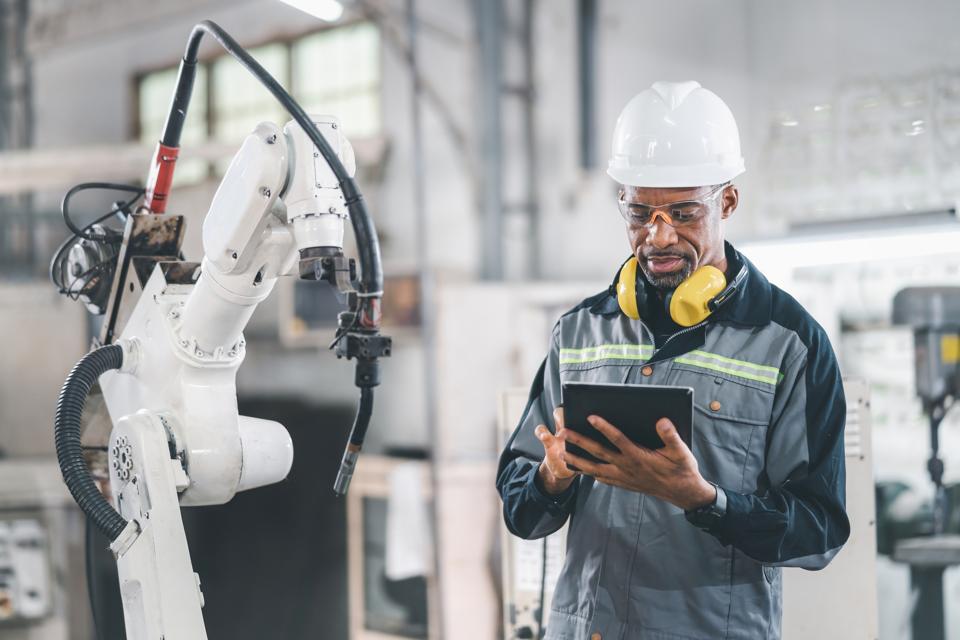
On the ground, we’re seeing tangible adoption of robotics and automation in industrial sectors. For example, robotic welders are doing shifts on production lines while inspection drones and automated cleaning systems are improving safety and efficiency in hazardous environments.
In logistics, mobile robots are increasingly being used to optimize handling and reduce manual strain. Meanwhile, sensor-integrated machines are running predictive maintenance strategies that help reduce unplanned downtime. Semi-autonomous control systems are also gaining traction, facilitating the remote operation of critical assets and plants and enabling safer, more flexible industrial operations.
Digital technologies are increasingly being layered onto automation platforms to unlock further efficiencies. These include energy optimization, mass balance, advanced process control and real-time operational data integration. The result is not just enhanced productivity, but a new era of more adaptive, resilient and intelligent industrial operations.
Real-World Robotics
In the U.S., for example, heavy equipment manufacturer Caterpillar is successfully using autonomous arms for welding and machining in its factories. These robots improve weld precision, cycle time and material usage efficiency. On one Cat mining truck, a robot and a welder working together can complete a weld 60% faster than a person working alone.
In a broader use case that highlights the deployment of robotics for predictive maintenance, a major Brazilian oil and gas (O&G) operator and customer of my company, Radix, has implemented a suite of digital automation and semi-autonomous technologies to modernize its aging floating production units. The Radix-supported initiative deployed a digital twin system to monitor 36 critical assets, including turbines, compressors and generators. The platform enabled real-time anomaly detection across 2,200 field instruments.
Within a year, the O&G operator saved approximately $2 million through optimized maintenance cycles and reduced downtime.
Augmentation, Not Replacement
Still, it is important to emphasize that the goal of these robots is not replacement but augmentation. By boosting precision, improving safety and taking on tasks that are dangerous, repetitive or physically taxing, automation can support rather than supplant the workforce.
This type of human-machine collaboration is essential for unlocking new levels of performance without requiring a complete overhaul of existing operations.
Shared Goals For Robotics
Industry leaders should begin by investing in small-scope, scalable robotics pilots that address real-world operational issues. Before launching any robotics initiative, it’s critical to break down organizational silos and prioritize interoperability. This starts with cross-functional working groups that include IT, OT and engineering, ensuring robotics is deployed to solve shared challenges, not isolated technical issues.
Equally important is the establishment of common standards across domains, including data formats, integration architectures and safety protocols. The ultimate goal is to build a modular, flexible robotics ecosystem that is capable of evolving alongside the business.
Cultural Considerations
All this said, organizations should be mindful not to overlook the cultural dynamics that can undermine even the most promising robotics initiatives. Resistance to change, fear of job loss and a lack of cross-functional communication are common obstacles. Given these concerns, it’s important to involve frontline teams early, invite their feedback and frame automation not as a job eliminator but as a tool to support human roles.
This kind of transparency, reinforced through regular communication, training and visible leadership support, fosters trust and lays the groundwork for a successful transformation.
Welcome To The Future, Today
Ultimately, robots have the potential to ease the transition from aging infrastructure to more future-ready operations, offering meaningful gains in productivity along the way. By considering these points above, you can be better positioned to shape—rather than simply react to—the next chapter of industrial evolution.
Forbes Technology Council is an invitation-only community for world-class CIOs, CTOs and technology executives. Do I qualify?
link