When Will We See Humanoid Robots on the Manufacturing Floor?


The Robotics Summit and Expo took place April 30-May 1 at the Boston Convention and Exhibition Center, bringing together developers working on robots in industries from manufacturing and logistics to healthcare, agriculture and more.
The robotics industry is fragmented. Robots exist for a wide range of industries, from manufacturing to healthcare to agriculture and beyond. Robots for each of these industries share common technologies, but they’re put together and deployed differently based on that industry’s specific needs. But this won’t always be the case — robot makers are working toward a general-purpose robot platform that could work across all industries: a humanoid robot.
Humanoid robots were a hot topic at the Robotics Summit and Expo, an event for robot developers held April 30-May 1 in Boston, Massachusetts. Humanoids were everywhere, from the show floor, where a teleoperated G1 humanoid robot from Unitree was interacting with attendees, to the presentations, which focused on both the big-picture and technical details of humanoids.
Aaron Saunders, CTO of robot maker Boston Dynamics, summed up the current state of humanoid robotics in his keynote address on the first day of the event, “The Promise of Humanoid Robots — Research Vs. The Real World.” In it, he laid out the current barriers robot developers currently face in their quest to create a form of general-purpose automation that can be deployed quickly.
- Body Control. The first challenge in humanoid robot development is body control. According to Saunders, the Boston Dynamics team is developing body control through whole-body humanoid reinforcement learning, which involves a human simulating movements that a humanoid robot then copies. Saunders showed a video of a person breakdancing in a motion-capture suit, followed by footage of Atlas, Boston Dynamics’ humanoid robot, performing the same movements. He reported that most of the motion translated over directly, with no manual editing required. Body control also goes beyond enabling movement — it’s also a safety issue, as Nikolai Ensslen, CEO of motion control company Synapticon pointed out during his presentation, “Making Autonomous Bipedals Stable and Safe: Tackling the Safety and Real-World Interfacing Challenges of Physical AI.” In most robotics, a stopped robot is a safe robot. But this doesn’t necessarily apply to humanoids, which are at risk of falling over when they stop. Sensors and software provide sufficient safety for traditional robot arms, but he noted that cameras and AI are needed for safe functioning of autonomous humanoids.
- Understanding Surroundings. Saunders said that visual foundation models (VFMs) can be used to give robots additional context on their environment. For example, Boston Dynamics’ robot dog Spot uses height to determine whether it should step over an obstacle or go around it. But VFMs give additional context on obstacles it would step over based only on height, but could still cause problems (wires, carts with wheels, grates).
- Object Manipulation. Boston Dynamics is advancing dexterous grasping capabilities via reinforcement training aided by NVIDIA Robotics’ DextrAH-RGB workflow, as Saunders showed in another video. Meanwhile, on the show floor, Psyonic was showcasing its touch-sensing bionic Ability Hand, which can be used as a prosthetic or for robots. The demonstration enabled a user to control the Ability Hand via a camera.
Saunders noted that these are software barriers, as most of the hardware barriers have already been overcome. Specifically, the primary challenge is that the highest quality of data needed to overcome these barriers is difficult to gather and therefore rare (for example, data collected from teleoperating robots), while the most common data is comparatively less helpful (text, images and video from the Internet).
Humanoids in Manufacturing and Beyond
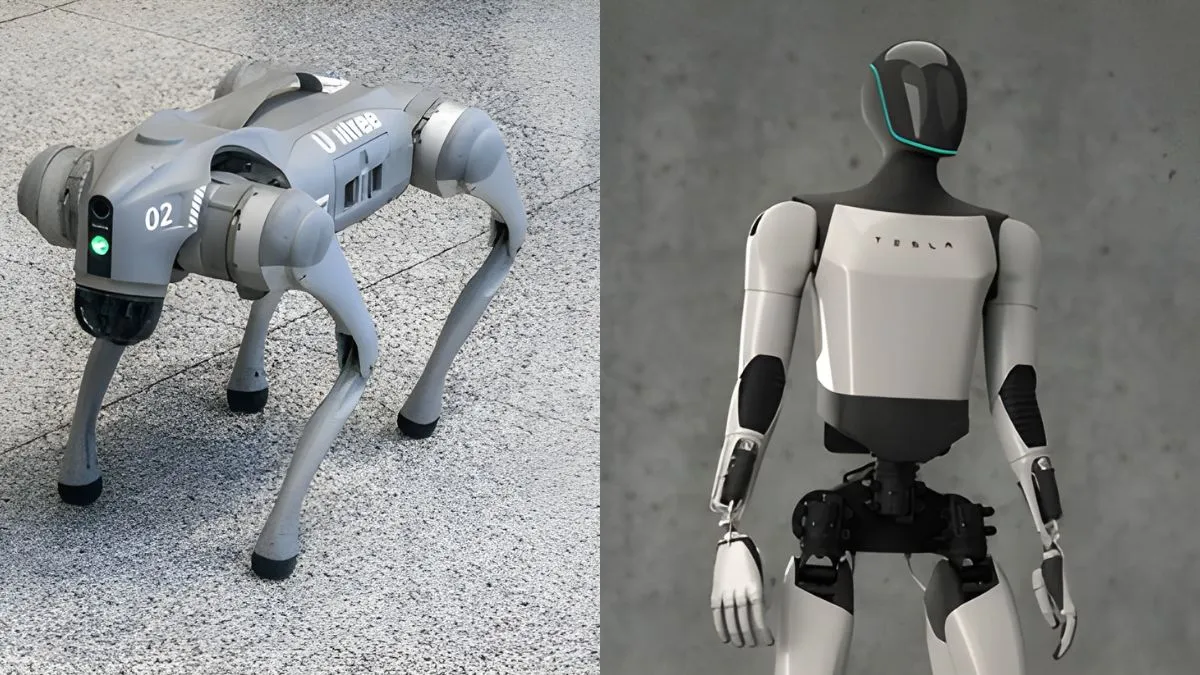
Manufacturing was another theme at the event. I heard more than once that the manufacturing industry, with its ongoing skilled labor shortage, presents the biggest opportunity for the robotics industry. And it’s not just the robot developers that have their eye on the manufacturing industry — the manufacturing industry is taking note of humanoid robots as well. Several large manufacturers have taken a stake in developing humanoid robots, including Hyundai Motor Company (which has an 80% stake in Boston Dynamics), Mercedez-Benz (which has a stake in Apptronik) and Tesla (which is working on its own humanoid robot). Once these robots exist in a form that can work on a factory floor, the industry will have to solve the challenge of industry adoption.
But a general-purpose humanoid robot won’t stop at manufacturing. In his presentation, Saunders noted that while today’s robots are industrial, meaning built for a specific purpose, Boston Dynamics’ ultimate goal is to develop multi-purpose service robots and, eventually, general robots for the home.
link